
Biosecurity · Inflatable rim · Drive-through
Vehicle disinfection berms
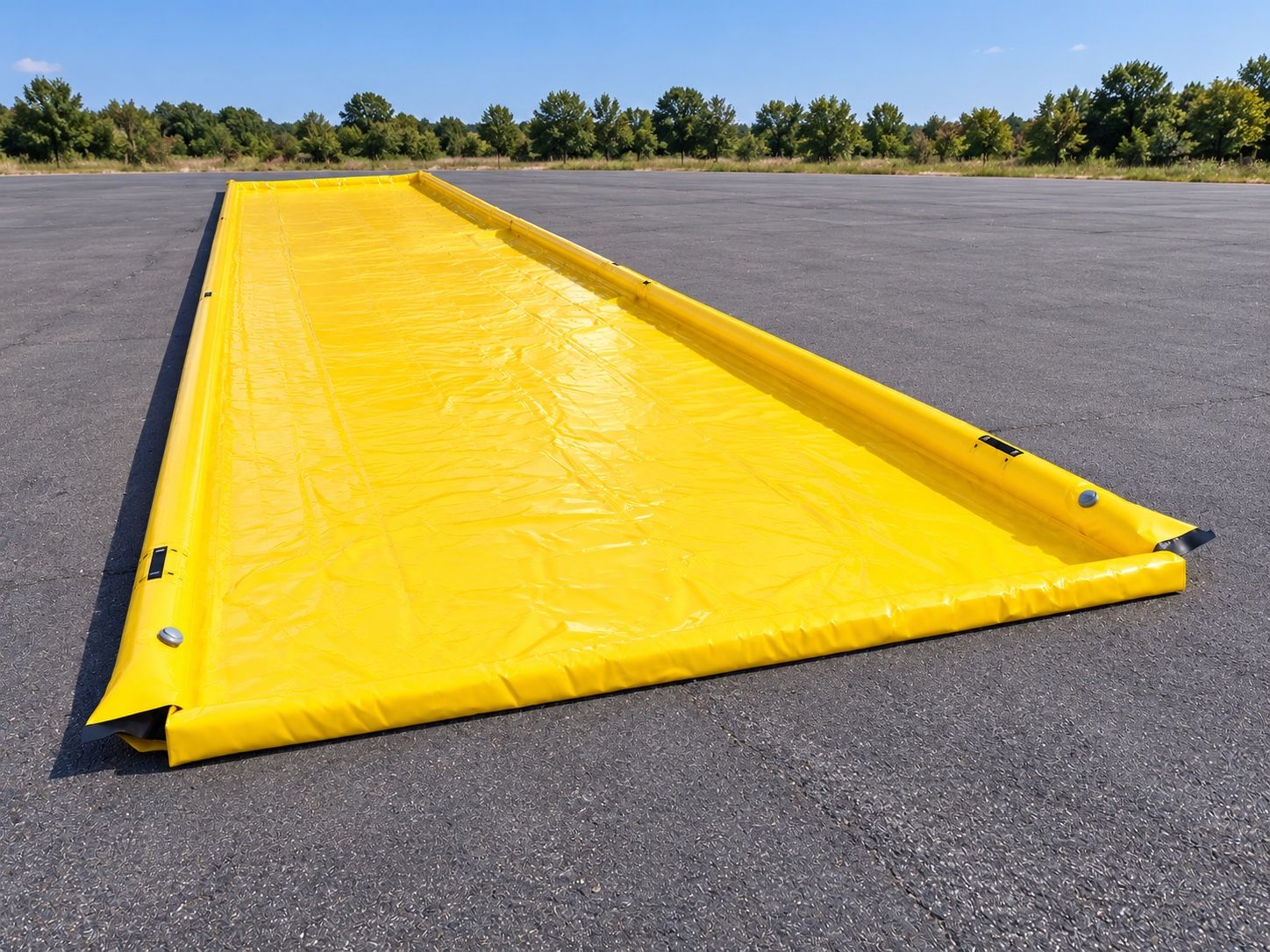
A shallow drive-through tray you fill with disinfectant, so tyres and wheels are treated on the way in and on the way out. The rim is an air tube rather than foam, so the whole set deflates into a pallet-sized box instead of filling a van. Made to size in our Taizhou factory for OEM and private-label distributors in the US, UK and Europe.
- Drive tyres and wheels through a shallow disinfectant bath
- Inflated rim instead of foam, so the whole set packs to a pallet box
- Inflated from a blower or an air cylinder, not a compressor rig
- Low ends, so a vehicle rolls in and out without ramps
- Line several up to build a pre-clean, disinfect, post-clean lane
This is not a spill berm
Everything else we make is waiting for something to go wrong. A spill berm sits empty under a tank or a vehicle and earns its keep on the day something leaks into it.
This one is the opposite. You put the liquid in on purpose. It holds a working depth of disinfectant that vehicles drive through, and it collects the washings that come off them. It is a piece of biosecurity equipment that happens to be made the same way as a containment berm.
That changes which numbers matter. Nobody asks how many gallons it holds, because it is a few centimetres deep by design. They ask how long the lane is, and how small it packs.
Containing a leak that is already happening from a parked or drive-in vehicle is a different job with a different shape — see drive-through spill berms.
Where the requirement actually comes from
Animal disease legislation in the UK and the EU requires vehicles to be cleansed and disinfected when movement controls are in force. It does not generally say the run-off has to be contained.
What makes containment necessary is a different body of law. Letting disinfectant and washings reach a drain or a watercourse is an offence under general water pollution rules, and concentrated disinfectant is a hazardous substance in its own right. US emergency response guidance goes further and explicitly describes using berm material to collect the run-off at a decontamination point.
So the honest position is this: the berm is not what the disease order asks for. It is what keeps you on the right side of everything else while you comply with it.
We do not quote the US SPCC rule on this page. That rule governs fixed oil storage and has nothing to say about a disinfection lane — it is the framework for our spill containment products, not this one.
Features
The rim is air, and that is the point
A foam rim of the same height has to be stored at full size for ever. An inflated tube deflates to almost nothing, which is what decides whether a set gets carried to a remote farm gate or stays in the depot.
Inflated with what is already on the truck
A fire-service blower or a breathing-air cylinder with an adapter does it. No compressor, no power supply, no specialist kit at the roadside.
Low ends, no ramps
The entry and exit are a low wedge rather than a wall, so a vehicle drives straight through at walking pace without hose bridges or loading ramps.
Welded, liquid-tight floor
PVC-coated polyester, CNC-cut and heat-welded. The floor holds a working bath of disinfectant and the wash water that comes off the vehicle with it.
Built as a lane, not a unit
Set two or three end to end and you have pre-clean, disinfect and post-clean stages. One berm is a checkpoint; three are a decontamination line.
Supplied as a working set
The berm on its own is half the job. An underlay to protect it from stones, drive-over mats where every tyre lands, and a repair kit are what make it survive a season.
The floor and rim are PVC-coated polyester. How the fabric is built, and how we weld it.
Sizes
This is the one product on this site that buyers specify in metres, so the table leads in metric. The size you need is decided by the vehicle: long enough that every tyre completes at least one full rotation in the bath, wide enough for the track of whatever is coming through.
| Ref. | External size | In feet | Rim height |
|---|---|---|---|
| VD-6 | 6.0 × 3.9 m | 19.7 × 12.8 ft | 200 mm / 7.9 in |
| VD-9 | 9.0 × 3.9 m | 29.5 × 12.8 ft | 200 mm / 7.9 in |
| VD-14 | 14.0 × 3.9 m | 45.9 × 12.8 ft | 200 mm / 7.9 in |
| VD-20 | 20.0 × 3.9 m | 65.6 × 12.8 ft | 200 mm / 7.9 in |
| VD-20W | 20.0 × 5.0 m | 65.6 × 16.4 ft | 200 mm / 7.9 in |
There is no capacity column, and that is deliberate. Filled to the top of the rim the smallest size here would hold over a thousand gallons, which is not how anyone uses it — the working bath is a few centimetres deep. Publishing a containment volume would be a true number that tells you nothing useful.
Any length is made to order, and several berms line up end to end to build a pre-clean, disinfect and post-clean lane. Given on the quotation for the sizes you ask about — every size is cut to order, so there is no single figure to publish.
On air rims, and what we say elsewhere
On our compact folding spill berms we argue against inflated walls. That is not a contradiction, and it is worth explaining rather than hoping nobody notices.
The question is whether anyone is standing there when the air goes. A spill berm left holding a drum in a yard between site visits can lose pressure quietly and be flat by the time someone comes back — and whatever it was containing is already out. A disinfection lane is staffed for as long as it is running. A soft tube gets noticed within a vehicle or two, patched or swapped, and the work carries on.
Same judgement, applied honestly in both directions. Where a failure would go unseen, we build rigid. Where someone is there to see it, the packed size is worth more than the redundancy.
About DEKON-G
You will see this term in European tenders and on suppliers' pages. It is a German fire-service and civil protection term for vehicle decontamination capability — a way of organising equipment and crews.
It is not a product standard. There is no dimension, pressure or performance figure attached to it, so no berm can meaningfully "meet DEKON-G", and we are not going to claim ours does. If a tender references it, send us the tender: what will actually be specified in the document is lane length, rim height and set contents, and those we can quote against.
Specifications
| Product | Mobile vehicle disinfection berm with an inflatable rim |
|---|---|
| Construction | PVC-coated polyester, CNC-cut and heat-welded, with welded air chambers forming the side rim |
| Fabric weight | The European convention for this product is around 900 g/m², which falls between two of our grades: 22 oz/yd² (745 g/m²) and 40 oz/yd² (1355 g/m²) |
| Rim | Air-filled tube along each long side |
| Inflation | From a blower or a compressed-air cylinder with an adapter |
| Ends | Low removable wedge at entry and exit so vehicles drive straight through |
| External height | 200 mm (7.9 in) as standard; other rim heights made to order |
| Sizes | Made to order. The lane length decides the size, not a containment volume |
| Capacity | Not the specification that matters here. This is a working bath a few centimetres deep, not a tray sized to hold a container’s full contents |
| Packed size | The number this product is chosen on Measured on a production sample rather than estimated, and not finished yet. Ask us for the current figure with your enquiry — it is the number this product is chosen on, so we are not going to approximate it |
| Weight | Berm and complete set listed separately. Given on the quotation for the sizes you ask about — every size is cut to order, so there is no single figure to publish |
| Set contents | Berm, underlay, drive-over mats, repair kit and lashing straps |
| Colour | European disinfection sets are commonly orange, and high-visibility yellow is the other usual choice. Yellow, black, blue, orange and green, at no extra cost and with no separate minimum — the colour is a choice of fabric roll, not a pigment batch, so changing it costs us nothing and we do not charge for it |
| Disinfectants | Send the product name and safety data sheet. Agricultural disinfectants vary widely and some are hard on coated fabric We have no published compatibility list for agricultural disinfectants. Send the product name and its safety data sheet and we will check it against the fabric rather than guess. |
| Branding | Private label and custom packaging for OEM orders |
| MOQ | 20 units per size. That is low for made-to-order containment, and it is deliberate: a distributor should be able to test a size on a real order rather than commit to a container of it |
| Lead time | Production takes 15 working days for up to 50 units and 25 working days for 50 to 200. Above 200 units we schedule it with the order. The clock starts when your deposit reaches us, not when the order is placed |
| Samples | Samples take 5 working days. We charge for the sample — the amount depends on the size, so it is quoted with your request — and we refund that charge against your first production order. Sample freight is on the buyer |
Where disinfection berms are used
Farm and holding gates
A checkpoint at the entrance to a livestock unit during a disease control zone, so every vehicle in and out passes through the bath.
Poultry and pig units
Where avian influenza or African swine fever controls are in force and vehicle movement is the route the disease travels.
Border and control posts
Temporary disinfection points set up on a road at short notice, where the kit has to arrive in a van and work within the hour.
Markets, abattoirs and collection centres
Places where vehicles from many premises meet, which is exactly where cross-contamination is worth stopping.
Civil protection and fire service
Vehicle decontamination as part of a wider response — what German services group under the term DEKON-G.
Machinery and plant movement
Earth-moving and agricultural machinery crossing between sites, where soil on the tracks is the thing being carried.
How to order
- Tell us the vehicle and the lane: what drives through, how long the bath has to be, and whether you want one stage or three.
- Tell us the disinfectant and send its safety data sheet, so the fabric is checked against what you will actually use.
- Say what goes in the set — underlay, drive-over mats, repair kit, straps.
- Production and shipment from our factory in Taizhou, Zhejiang, China.
For distributors
This is a set, not a unit — berm, underlay, mats, repair kit and straps — and it sells at set prices rather than berm prices. Most of what goes in it we already make, and the rest is bought in.
It also sells on a different cycle from the rest of this range: demand arrives with an outbreak and a movement control zone, which means buyers are governments, veterinary authorities and agricultural merchants rather than industrial safety distributors.
Questions about vehicle disinfection berms
What is a vehicle disinfection berm?
A shallow drive-through tray you fill with disinfectant so vehicle tyres and wheels pass through it. Unlike a spill berm it is not waiting to catch a leak — you deliberately put liquid in it, and it also collects the wash water that comes off the vehicle. It is used where vehicle movement is the way a disease travels between premises.
Is this the same as a disinfection mat?
No. A disinfection mat is a flat absorbent pad with no rim; it wets the tyre but holds almost nothing and anything that runs off goes to ground. This has a raised rim and a welded floor, so it holds a working depth of disinfectant and keeps the run-off inside it.
Why an inflatable rim instead of foam?
Storage and transport. A foam rim has to be stored at full height for ever; an inflated one deflates to almost nothing, so a complete set fits in a pallet-sized box rather than filling a van. For kit that has to reach a farm gate at short notice, that difference is what decides whether it is carried at all.
What do you inflate it with, and how long does it take?
A fire-service blower or a compressed-air cylinder with the right adapter. No compressor or power supply is needed. Exact inflation time depends on the rim volume and the blower, so ask us for the figure on the size you are quoting rather than taking a general number.
What happens if the rim is punctured while it is in use?
That is the honest question to ask about any air-walled product, and the answer depends on how the rim is built — how many separate chambers it has, and whether losing one drops the whole side. We will tell you exactly how ours is divided once the design is fixed, rather than glossing over it. A disinfection line is staffed while it is running, so a puncture gets patched or the tube swapped between vehicles.
Is a berm like this legally required?
Not directly, and you should be wary of anyone who says it is. Animal disease legislation in the UK and EU requires that vehicles be cleansed and disinfected; it does not generally specify that the run-off be contained. What makes containment necessary is separate: letting disinfectant and washings reach a watercourse or a drain is an offence under general water pollution law, and concentrated disinfectant is a hazardous substance in its own right.
What is DEKON-G?
It is a German fire-service and civil-protection term for vehicle decontamination capability, not a product standard with numbers in it. You will see suppliers reference it because German services organise their kit that way. Nobody can meaningfully claim a berm "meets DEKON-G", because there is no dimension or performance figure to meet — treat it as a description of the job, not a certification.
What do you do with the used disinfectant?
It is a waste stream and it belongs to you, not to the berm. Spent disinfectant mixed with mud and organic matter is normally pumped out and disposed of under the rules for the disinfectant concerned. What the berm does is keep it in one place so you have the choice.
How many vehicles can pass through before the bath is spent?
That depends entirely on the disinfectant, its dilution and how dirty the vehicles are, and it is the disinfectant manufacturer who specifies it — not us. Organic matter deactivates most agricultural disinfectants, which is why a pre-clean stage exists at all.
Can berms be put end to end to make a longer lane?
Yes, and that is how a proper decontamination line is built: a pre-clean stage, a disinfection stage and a post-clean stage in sequence. Tell us the lane you want and we will quote the units to make it up.
Which disinfectants can it handle?
Send the product name and its safety data sheet with your enquiry. Agricultural and veterinary disinfectants vary a lot — some peroxygen and halogen-based products are much harder on coated fabric than others — so the fabric should be checked against what you will actually be using.
Specifications on this page are confirmed with the factory; anything still marked TBC is a gap we have left visible rather than filled with a plausible number. Checked by the production team at Taizhou Fengxu Textile Industry Co., Ltd. on . How we verify what is on this site.
Quote a vehicle disinfection berm
Send the inner size or equipment footprint, the liquid, the quantity and the destination. We reply with a quote by email.