
Rail spill response · Dual-sump · Camlock drained
Railcar spill containment berms
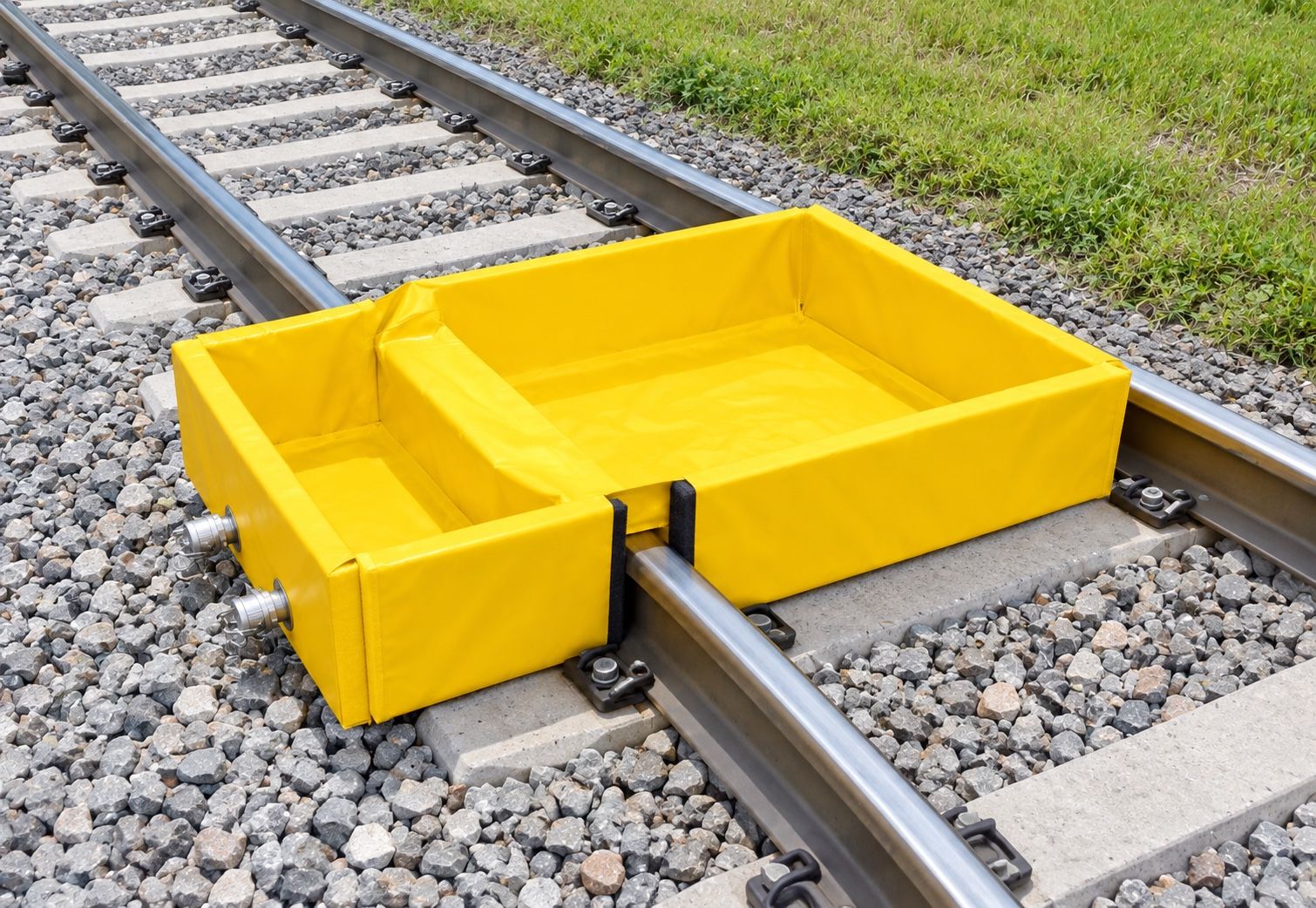
A portable containment unit that straddles the rail and goes under a leaking railcar or locomotive. One person carries it to the leak, drops it over the rail and straps it down; two fittings drain it to a drum or a vacuum truck. Made in our Taizhou factory for OEM and private-label distributors in the US, UK and Europe.
- Straddles one rail, with a sump on each side of it
- Carried to the leak by one person and deployed on live ballast
- Two cam-and-groove fittings drain it to a hose, not a bucket
- Heavier fabric than a yard berm, because the ballast is sharper
- Narrow-gauge widths made to order — not a single fixed SKU
Response, not transfer
We make two products for rail, and picking the wrong one wastes an order. The difference is not the vehicle — it is whether the liquid is already on its way out.
| Transfer berm | Railcar spill berm | |
|---|---|---|
| When it is used | During a planned loading or unloading transfer | After a leak has already started, wherever the car happens to be |
| Shape | A flat pad sized to your discharge point | A fixed-size unit that straddles the rail itself |
| Where it sits | On a transfer pad or hardstanding, under a valve | On ballast and sleepers, under the car |
| Who deploys it | The loading crew, as part of rigging the job | Whoever finds the leak, usually alone and in a hurry |
| Sizing | Made to your footprint | One reference size covers standard gauge; narrow gauge is made to order |
Catching routine drips at the valve during a planned loading or unloading transfer is a different job with a different shape — see tanker and railcar transfer berms.
How it is built
Two sumps, one rail
A raised channel down the middle lets the rail pass through the berm at grade. Either side of that channel is a separate sump, so drips landing inboard and outboard of the rail are both caught.
Strapped over the rail
Webbing straps pass over the rail head and hold the unit in place on ballast, where there is nothing to peg into and nothing flat to sit on.
Foam walls, no hardware
The walls are foam-filled sleeves. Brackets and stays would not stand on ballast, and anything loose on live track is something that gets left behind.
Drained, not bailed
Two cam-and-groove fittings at floor level take a hose, so what is caught goes to a drum or a vacuum truck without the unit being lifted or tipped.
Built for ballast
Crushed stone is harder on coated fabric than any yard floor. This is the one product in our range where the benchmark specification runs to roughly double the usual fabric weight.
One person, one trip
The point of a portable unit is that it reaches the leak before a crew can rig anything permanent. Benchmark units weigh around 24 lb for exactly that reason.
Everything is cut and welded from PVC-coated polyester, in a heavier weight than the rest of our range.
Gauge is the sizing question, and one size does not fit all of it
The unit straddles one rail, so what constrains it is the rail section, not the distance between the rails. That is why a single width works across most of the world's mainline track — and why it stops working on narrow gauge, which the Western catalogues do not address at all.
| Gauge | Width | Where | Reference-width unit |
|---|---|---|---|
| Standard / UIC | 1,435 mm (4 ft 8½ in) | Most of the US, UK and EU network | Reference width fits with clearance |
| Russian | 1,520 mm | Russia and ex-USSR states | Fits |
| Iberian | 1,668 mm | Spain, Portugal | Fits |
| Indian | 1,676 mm | India, parts of South America | Fits, most clearance of all |
| Cape | 1,067 mm (3 ft 6 in) | Southern and East Africa, Japan, parts of Australia | Tight — two units cannot both sit at full width |
| Metre | 1,000 mm | Parts of Africa, Southeast Asia, South America | Reference width is wider than the gauge; needs a narrower build |
The 48 in reference width is what both Western manufacturers in this category settled on, and it is right for standard gauge. On metre gauge the track itself is narrower than that unit, so a full-width pair cannot be deployed at all. We would rather build the width your track takes. Yes — it is the same product cut to a different width. Send us the gauge.
Over one rail, or between both?
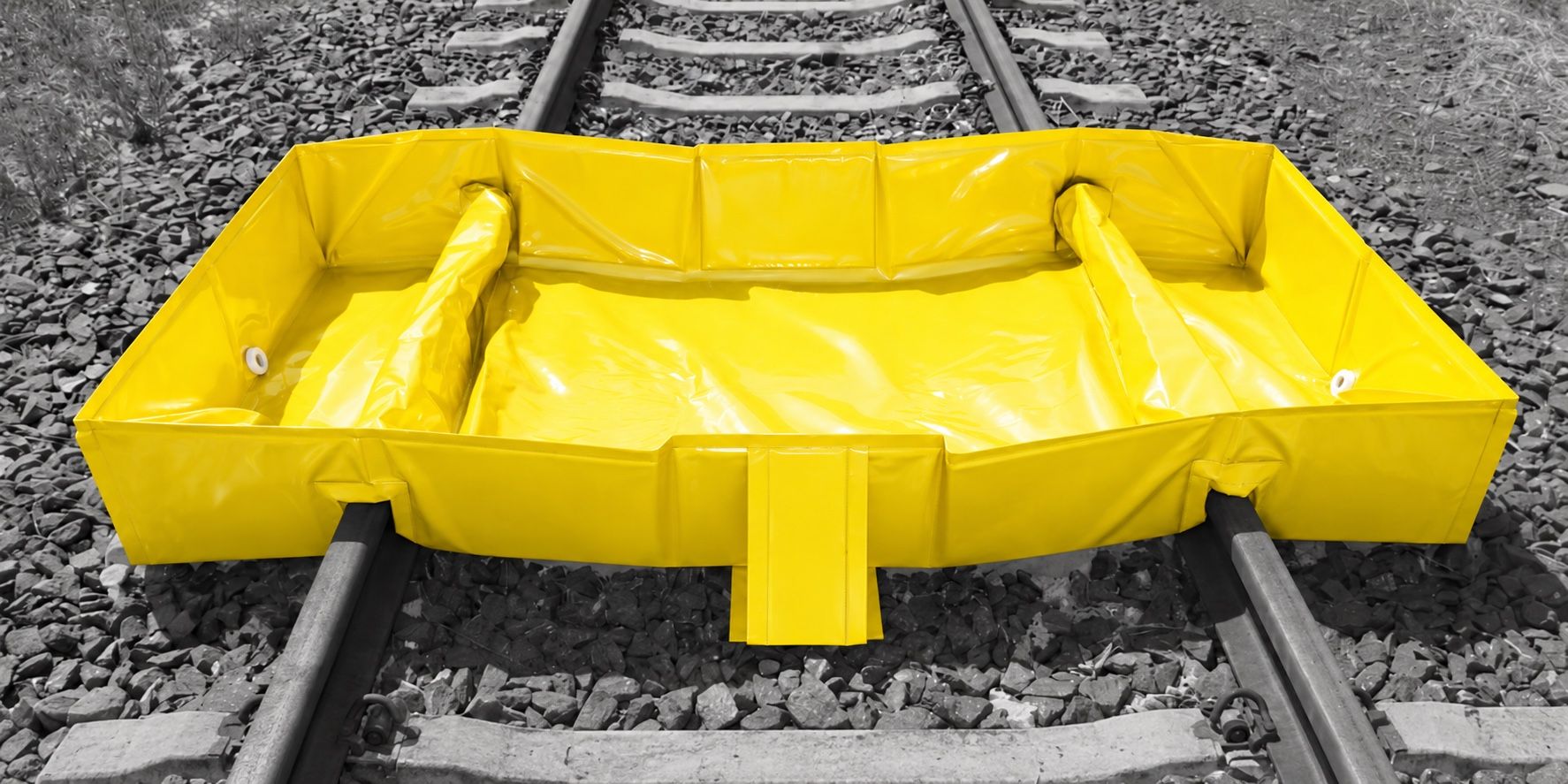
There are two ways this job is solved, and the markets split along them. North American units straddle a single rail; European ones sit in the four-foot with the walls notched down over both rails. We build either — the right one depends on where the leak lands and how much room there is beside the track.
| Over one rail | Between both | |
|---|---|---|
| Where it sits | Astride one rail, with a sump on each side of it | In the four-foot, walls notched down over both rails |
| Gauge | Gauge-agnostic — it only has to fit one rail section | Built to the gauge; a different gauge is a different unit |
| Ground taken outside the track | A sump sits outboard of the rail | None — the whole unit is inside the track |
| Typical volume | Around 450–545 L on the US benchmark | Around 800 L on the European benchmark |
| Drain fittings | Cam-and-groove, the US convention | GEKA, the European fire-service convention |
| Suits | A drip from one side of the car; crews working outboard | A leak onto the track centre; stations, depots and sidings |
The trade is gauge against clearance. Straddling one rail works on any gauge but needs room beside the track. Sitting between the rails needs no outside room at all, but the unit is cut to that gauge and will not fit another. Any gauge, cut to order.
Fittings are a market question, not a technical one. North American crews expect cam-and-groove; European fire and rail services expect GEKA. Tell us where the unit is going and it is specified accordingly — there is no reason to ship a coupling nobody on site has a hose for.
Why we do not publish a capacity yet
The reference size is 72 × 48 × 12 in. Run that through the usual formula and you get about 180 US gallons. That number is wrong, and we are not going to print it.
The centre channel the rail passes through is not containment volume. Of the two Western units at exactly this size that publish a capacity, one states 144 US gallons and the other 120 — same outside box, 20% apart, because how wide you make that channel is a design decision, not a constant.
So there is no honest way to calculate ours from the outside dimensions. We will publish a measured figure once our own channel geometry is fixed. We publish measured capacity, not calculated capacity, and this size has not been water-tested yet. If you are sizing to a regulation, ask us before you order and we will tell you exactly where that stands rather than hand you the geometric figure.
What the rules actually say
Our other berm pages cite the US SPCC rule, because it governs the fixed storage those products serve. This page does not, and the reason is worth knowing.
SPCC explicitly excludes equipment under the authority of the Department of Transportation. A rail tank car in transit is exactly that. Railcars and the track they stand on are governed by FRA and PHMSA rules and by the operating railroad's own hazmat procedures, which require a crew to be able to capture and collect a spill — but do not state a containment volume the way SPCC does for tanks.
So this berm helps a crew contain an active leak quickly. It does not, by itself, satisfy a numeric regulatory requirement, and you should be wary of any supplier in this category who tells you otherwise. How the rules work for fixed storage.
Specifications
| Product | Railcar spill containment berm: dual-sump, straddles one rail, camlock-drained |
|---|---|
| Construction | PVC-coated polyester, CNC-cut and heat-welded, with a raised centre channel the rail passes through and a sump on each side |
| Centre channel | |
| Walls | Closed-cell polyethylene foam, sealed inside a welded sleeve. Closed cell, not open cell: a wall that has to stand in standing liquid — and on some of our berms float up in a spill — cannot be a sponge, and a cut in the cover does not turn it into one — no brackets or stays to stand on ballast. The wall is square in section, as wide at the base as it is tall. A 4 in (100 mm) wall takes 4 in of floor along each side, a 6 in (150 mm) wall takes 6 in — so the inner floor is always the outside size less twice the wall height |
| Fabric weight | 40 oz/yd² (1355 g/m²). Ballast is far harder on coated fabric than a workshop floor, so rail units run on our heaviest grade — more than twice the weight of a yard berm |
| Reference size | 72 × 48 × 12 in (1,829 × 1,219 × 305 mm) — the size both Western benchmarks converge on |
| Narrow-gauge width | Made to your gauge. A narrower unit for metre-gauge and Cape-gauge track is the same product cut to a different width — send the gauge with your enquiry |
| Capacity | We publish measured capacity, not calculated capacity, and this size has not been water-tested yet. If you are sizing to a regulation, ask us before you order and we will tell you exactly where that stands rather than hand you the geometric figure |
| Drain | Fittings through the sidewall at floor level, specified to your market: cam-and-groove for North America, GEKA for European fire and rail services |
| Securing | Webbing straps over the rail head |
| Weight | Built so one person can carry and place it — that is the point of the product. Given on the quotation for the sizes you ask about — every size is cut to order, so there is no single figure to publish |
| Load rating | European rail bunds of this type publish a carrying capacity, typically around 200 kg We have not published a rated load for this product, and we are not going to quote one we have not tested. Tell us what will stand on it and how heavy it is, and we will establish the rating before you order |
| Temperature range | The European benchmark for this product states −30 °C to +70 °C Ask us with your climate and your liquid. We would rather check the fabric and the foam against your conditions than publish one range and have you assume it covers a cold store or a desert yard |
| Colour | Black is the convention for rail units in the US and Europe, and it is what we would suggest; yellow is the high-visibility alternative. Yellow, black, blue, orange and green, at no extra cost and with no separate minimum — the colour is a choice of fabric roll, not a pigment batch, so changing it costs us nothing and we do not charge for it |
| Liquids | Send the Safety Data Sheet so the fabric can be checked before you order |
| Branding | Private label and custom packaging for OEM orders |
| MOQ | 20 units per size. That is low for made-to-order containment, and it is deliberate: a distributor should be able to test a size on a real order rather than commit to a container of it |
| Lead time | Production takes 15 working days for up to 50 units and 25 working days for 50 to 200. Above 200 units we schedule it with the order. The clock starts when your deposit reaches us, not when the order is placed |
| Samples | Samples take 5 working days. We charge for the sample — the amount depends on the size, so it is quoted with your request — and we refund that charge against your first production order. Sample freight is on the buyer |
How to order
- Tell us the gauge and the rail section, because that decides the width.
- Tell us the liquid and send the Safety Data Sheet, so the fabric can be checked.
- Say how many units per site — response kits are usually bought in pairs or by the yard, not singly.
- Production and shipment from our factory in Taizhou, Zhejiang, China.
For distributors
The Western products in this category are sold in a single width, aimed at standard-gauge networks. If you sell into a market that runs Cape or metre gauge, there is currently no catalogue answer for it — that is an opening, and it is the kind of thing a factory can fill and an importer cannot.
Questions about railcar spill containment
What is a railcar spill containment berm?
A portable tray that straddles a rail and sits under a leaking railcar or locomotive. A raised channel down the middle lets the rail pass through, and a sump on each side of that channel catches what drips. Two fittings at floor level let a crew drain it to a drum or a vacuum truck rather than lifting it.
Is this the same as a track pan?
No. A track pan is a permanent or semi-permanent installation built into a siding, sized and fixed for that location. This is the opposite: it is carried to wherever the leak is, deployed in minutes and taken away again. If your problem is a known drip point at a fixed siding, a permanent pan is the better answer.
Is this different from your tanker and railcar transfer berm?
Yes, and the difference is when you reach for it. The transfer berm is a flat pad sized to your discharge point, put down as part of rigging a planned loading or unloading job. This one is for a leak that has already started, wherever the car is standing, so it has a fixed size and a shape that fits over the rail instead of beside it.
What does dual-sump mean?
The rail divides the unit into two separate collecting areas, one inboard and one outboard. It is not one big tray with a bump in it: each side holds liquid independently, which is what allows the unit to sit over live track at all.
How is it placed under a railcar that is already leaking?
It is light enough for one person to carry to the car, and it goes down onto the ballast over the rail rather than needing a flat surface. Straps over the rail head hold it. That is the whole design brief: get containment under the drip before anyone rigs anything more substantial.
Does it fit any rail gauge?
The unit straddles one rail, so what matters is the rail section, not the distance between the rails. At standard, Russian, Iberian and Indian gauge the reference width fits with room to spare. At Cape gauge and metre gauge it is tight or too wide, and a narrower build is the right answer — tell us the gauge you are buying for.
Can you make a narrower size for metre-gauge or Cape-gauge track?
That is exactly the kind of thing a factory can do and a fixed-SKU catalogue cannot. The Western products in this category are sold in one width, which suits the standard-gauge markets they were designed for. Tell us the gauge and we will quote a unit built for it.
Why is the capacity lower than length × width × height would suggest?
Because the centre channel the rail passes through is not containment volume. On the two Western units of this size that publish a figure, the stated capacity is between 67% and 80% of the box volume — and those two differ from each other, because the channel width is a design choice, not a constant. That is why we will publish a measured figure rather than a calculated one.
Do I need a pump to empty it, or does it drain on its own?
It drains by gravity through the fittings if you have somewhere lower to drain to, which on ballast you often do not. In practice most crews connect a hose to a vacuum truck or a drum pump. Either way the unit is not lifted or tipped with liquid in it.
Why is the fabric heavier than your other spill berms?
Because crushed ballast is the harshest surface any of our products get put on, and this one gets dragged across it in a hurry rather than laid out carefully. The Western benchmark for rail units is roughly double the fabric weight of a yard berm, and that is the right instinct.
Is this required by SPCC or EPA regulations?
No, and be careful of anyone who says it is. The US SPCC rule explicitly excludes equipment under the authority of the Department of Transportation, which is what a rail tank car in transit is. Railcars and track are governed by FRA and PHMSA rules and by the operating railroad’s own hazmat procedures, which require a crew to be able to capture and collect a spill but do not specify a containment volume the way SPCC does for fixed storage.
What happens to the drained liquid?
That is your waste stream and your procedure, not something the berm decides. The fittings exist so the collected product goes into a container you control — a drum, a tote or a vacuum truck — rather than being tipped onto the ballast when the unit is moved.
Specifications on this page are confirmed with the factory; anything still marked TBC is a gap we have left visible rather than filled with a plausible number. Checked by the production team at Taizhou Fengxu Textile Industry Co., Ltd. on . How we verify what is on this site.
Quote a railcar spill containment berm
Send the inner size or equipment footprint, the liquid, the quantity and the destination. We reply with a quote by email.