
Drum spill decks · Fabric sump, removable grating
Flexible spill decks
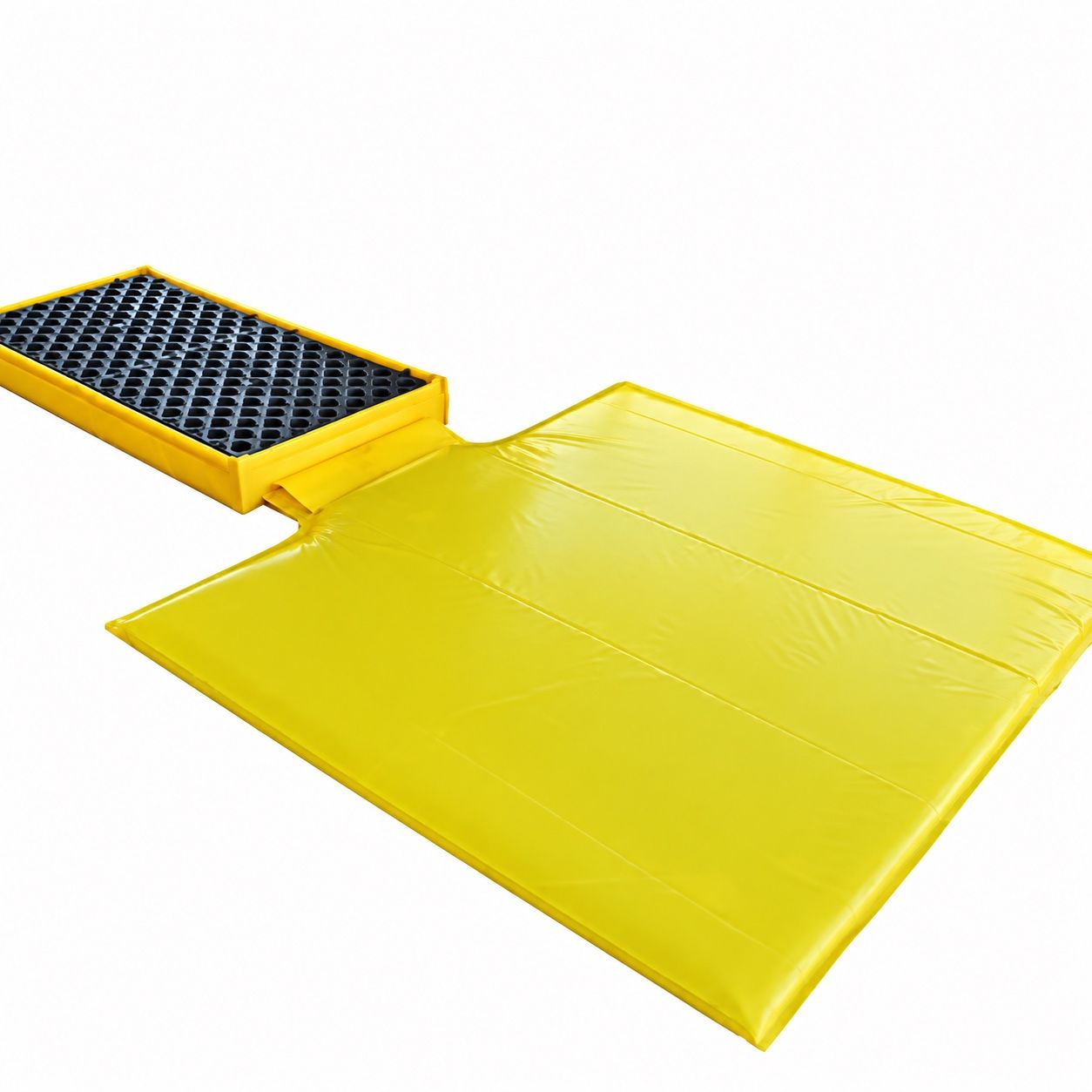
A low drum platform with a PVC-coated fabric sump instead of a moulded plastic one. Drums stand on a removable grating; drips fall through into the sump; lift the grating out and the whole deck folds flat. Made to size in our Taizhou factory for OEM and private-label distributors in the US, UK and Europe.
- Fabric sump instead of moulded plastic, so it folds flat for storage and shipping
- Removable grating lifts out for cleaning
- Decks link together, or add a bladder, to reach a full-drum capacity
- Made for 1, 2 and 4 drums, or to your own layout
- OEM and private label from our PVC factory
What a spill deck is, and what it is not
A spill deck is a platform, not a tray with walls. Drums stand on a grating, up out of anything that has leaked, and the leak collects in a shallow sump underneath. It is sized in drums — one, two, four — rather than in feet.
That makes it a different product from the rest of our range. A spill containment berm is an open tray sized in feet, with walls, and whatever it holds sits on the floor of the berm. For IBCs, tanks or a group of drums in one footprint, the berm is the right answer.
What makes this deck flexible is the sump: coated fabric rather than moulded polyethylene. Take the grating out and it folds flat. A distributor stocks several times as many units in the same warehouse bay, and the freight cost per unit drops accordingly.
The grating is doing more than holding the drums up off the fabric. The US container-storage rule at 40 CFR 264.175(b)(2) is written as an either/or: the base must be sloped and the liquid drained away, “unless the containers are elevated or are otherwise protected from contact with accumulated liquids.” A grating is that second route — the drum never stands in its own leak. It does not, on its own, answer the separate capacity requirement in (b)(3), which is what the bladder option further down this page is for.
Features
It ships flat, not as a box of air
A rigid moulded sump is mostly empty space in a container. Replacing it with coated fabric drops the shipped volume of a deck to a fraction of the rigid equivalent, which is the whole reason this version exists.
Drums stand on the grating
The grating carries the load and keeps drums up out of anything that has leaked. Lift it out and the sump underneath is a plain welded tray you can wipe down.
Welded, not stitched
The sump is PVC-coated polyester, CNC-cut and heat-welded like the rest of our containment range, so there are no needle holes anywhere below the liquid line.
Link decks to share capacity
A bulkhead fitting between two sumps lets them hold liquid as one. That is how a row of small decks is built up to the capacity a regulation asks for.
Grating and sump from one factory
We make the grating ourselves instead of buying it in, so the deck arrives as one part number, the load rating comes from us, and a replacement grating is not somebody else’s lead time.
Any layout, made to order
One drum in a workshop corner, a four-drum square, or a long in-line run against a wall. Send the drum count and the space you have.
The sump is PVC-coated polyester, not a PE tarp. How the fabric is built, and how we weld it.
Sizes and capacities
One, two and four drums are the sizes this class is built around. Other layouts, including long in-line runs against a wall, are cut to order.
| Ref. | Drums | Outside size | Tray volume before the grating | Usable capacity |
|---|---|---|---|---|
| SD-1 | 1 drum | 24 × 24 × 2.5 in 610 × 610 × 64 mm | 6.2 US gal 23.6 L | Not yet measured |
| SD-2 | 2 drums | 48 × 24 × 2.5 in 1219 × 610 × 64 mm | 12.5 US gal 47.2 L | Not yet measured |
| SD-4 | 4 drums | 48 × 48 × 2.5 in 1219 × 1219 × 64 mm | 24.9 US gal 94.4 L | Not yet measured |
Read that fourth column carefully. It is the volume of the bare tray, and it is an upper bound, not a sales figure. The grating and its support ribs stand inside the sump and take up part of it. On the two Western products we measured against, that loss runs between 12% and 20% — a real spread, because it depends on the grating design. We will publish our own usable capacity once a production sample has been water-tested, not before.
What a deck this size will and will not do for compliance
This is the part most catalogues skate over, so here is the arithmetic in full.
The US rule for container storage asks the containment to hold 10% of the total volume, or the volume of the largest container, whichever is greater. For a single 55 US gallon drum that is 55 gallons.
The largest deck on this page holds about 24.9 US gallons of bare tray volume, and less once the grating is in. So on bare decks alone it takes roughly 3 of them linked together to legally cover one drum. That is a lot of floor space for one drum, and it is the honest answer.
Two ways round it, and we build both: link decks with bulkhead fittings so a row shares one pool of capacity, or fit a bladder that stays folded in its housing until a large spill deploys it. The bladder is the one that does not cost you floor space.
The 10% clause only becomes the governing number once you have more than ten identical drums on one containment system. Below that, the largest single container is always the bigger figure.
We do not say "EPA compliant"
The EPA does not certify or approve containment products, so no deck or berm can be "EPA compliant" as a product. A deck helps a site meet the containment it has to provide, when it is sized and linked correctly. Anyone selling you a category as pre-approved is skipping the arithmetic above.
Bladder option: we build it
A folded bladder sits in a housing on the edge of the deck. In a large spill it deploys across the floor and holds what the shallow sump cannot, without taking any more space while it is stowed. It is how one deck covers a full drum instead of three linked ones. We publish measured capacity, not calculated capacity, and this size has not been water-tested yet. If you are sizing to a regulation, ask us before you order and we will tell you exactly where that stands rather than hand you the geometric figure.
Or make the sump deeper, and skip the arithmetic
Linking decks and fitting a bladder both solve the shortfall. There is a third answer that is easier to explain to a buyer: build the sump deep enough that one unit covers a full drum on its own. This is the configuration normally sold as a flexible spill pallet — the same fabric sump and removable grating as the decks above, just deep enough to stop the arithmetic being a problem.
| Ref. | Drums | Outside size | Tray volume | Load rating |
|---|---|---|---|---|
| SD-2D | 2 drums | 48 × 24 × 14 in 1219 × 610 × 356 mm | 69.8 US gal | 1,200 lb (545 kg) |
| SD-4D | 4 drums | 48 × 48 × 7 in 1219 × 1219 × 178 mm | 69.8 US gal | 2,400 lb (1,089 kg) |
Both configurations hold the same volume on purpose — one is tall and narrow, the other wide and shallower. Either clears the 55 US gallons a single drum needs without linking anything or fitting a bladder. Load ratings above are the market convention for these sizes. We have not published a rated load for this product, and we are not going to quote one we have not tested. Tell us what will stand on it and how heavy it is, and we will establish the rating before you order.
A deeper sump also loses proportionally less to the grating. On a 2.5 in tray the grating and its ribs take a serious bite out of a shallow volume; at 7 or 14 in the same hardware is a much smaller fraction of it.
What holds the walls up
On a deep fabric sump the sidewalls are held by hooks or ties attaching them to the grating. That is worth knowing before you buy: it is a working system, but it is not the same as a moulded wall that stands whatever you do to it. The market leader says so plainly in its own FAQ, and so do we.
It does not take a forklift
There are no fork pockets, and a loaded unit is not something to move. Set it where it is going to live, then put the drums on it. If the pallet has to be handled by a truck with drums on it, you want a rigid moulded one and we are not the right supplier.
Flexible deck or rigid deck?
We make the flexible kind. It is worth knowing plainly where it wins and where it does not, because the trade is real.
| Rigid moulded deck | Flexible fabric deck | |
|---|---|---|
| Sump | Moulded polyethylene, fixed shape | PVC-coated fabric, folds flat when the grating is out |
| Shipping and storage | Ships as its full assembled volume | Ships flat; a stack of decks takes a fraction of the space |
| Capacity for the same footprint | Higher — a deeper sump is easy to mould | Lower — depth is what was traded away for foldability |
| Meeting a full-drum requirement | Often possible from one unit | Usually needs several decks linked, or a bladder |
| Repair | A cracked sump is scrap | Fabric can be patched |
Smaller than a drum? Flexible spill trays are the same idea with no grating and no structure at all — one folded piece for catching drips off parts and cans. Want the grating but not the folding? Rigid containment trays keep their shape empty and are cut to whatever footprint you need.
Need containment sized in feet rather than drums? L-bracket spill berms and stay-supported spill berms are the IBC and tank answer.
Specifications
| Product | Flexible spill deck: PVC-coated fabric sump with a removable grating, for drums standing in place |
|---|---|
| Sump | PVC-coated polyester, CNC-cut and heat-welded, same material family as our berm range |
| Fabric weight | 18 oz/yd² (610 g/m²) as standard, or 22 oz/yd² (745 g/m²) heavy duty where the ground or the traffic is rough. We also run 40 oz/yd² (1355 g/m²) for rail work |
| Grating | Removable HDPE grating, made in our own factory rather than bought in, so the deck and the grating are quoted and shipped as one part number We have not published a rated load for this product, and we are not going to quote one we have not tested. Tell us what will stand on it and how heavy it is, and we will establish the rating before you order |
| Load rating | Market convention for the deep-sump sizes is 1,200 lb for two drums and 2,400 lb for four We have not published a rated load for this product, and we are not going to quote one we have not tested. Tell us what will stand on it and how heavy it is, and we will establish the rating before you order |
| Sump depth | 2.5 in (64 mm) for a drip tray; 7 in or 14 in where one unit has to cover a full drum on its own |
| Usable capacity | We publish measured capacity, not calculated capacity, and this size has not been water-tested yet. If you are sizing to a regulation, ask us before you order and we will tell you exactly where that stands rather than hand you the geometric figure |
| Sizes | 1, 2 and 4 drums as standard; other layouts made to order |
| Colour | High-visibility yellow sump with a black grating as standard. Yellow, black, blue, orange and green, at no extra cost and with no separate minimum — the colour is a choice of fabric roll, not a pigment batch, so changing it costs us nothing and we do not charge for it |
| Linking decks | A bulkhead fitting between two sumps lets them share capacity |
| Bladder option | Available. A folded bladder sits in a housing at the edge of the deck and deploys when a large spill arrives, adding capacity without adding footprint. Specified so that one deck plus a bladder covers a full 55 US gallon drum We publish measured capacity, not calculated capacity, and this size has not been water-tested yet. If you are sizing to a regulation, ask us before you order and we will tell you exactly where that stands rather than hand you the geometric figure |
| Folded size | Measured with the grating out. Given on the quotation for the sizes you ask about — every size is cut to order, so there is no single figure to publish |
| Weight | Sump and grating listed separately. Given on the quotation for the sizes you ask about — every size is cut to order, so there is no single figure to publish |
| Liquids | Send the Safety Data Sheet so the fabric can be checked before you order |
| Branding | Private label and custom packaging for OEM orders |
| MOQ | 20 units per size. That is low for made-to-order containment, and it is deliberate: a distributor should be able to test a size on a real order rather than commit to a container of it |
| Lead time | Production takes 15 working days for up to 50 units and 25 working days for 50 to 200. Above 200 units we schedule it with the order. The clock starts when your deposit reaches us, not when the order is placed |
| Samples | Samples take 5 working days. We charge for the sample — the amount depends on the size, so it is quoted with your request — and we refund that charge against your first production order. Sample freight is on the buyer |
| Packing | Every size packs differently, so there is no single carton spec worth publishing. Folded size, carton dimensions and gross weight go with the quotation for the sizes you are ordering — before you commit to freight, not after |
Where flexible spill decks are used
Workshop and plant rooms
A drum or two of oil, coolant or solvent standing where a forklift is not going to reach them.
Stores and goods-in
Holding stock drums on a floor that has to stay clean, with the deck folded away when the stock moves.
Laboratories and small workshops
Single-drum decks under dispensing points where the whole footprint has to stay small.
Mobile and hired kit
Decks that travel with a crew and get set up on site, then folded back into the van.
Seasonal storage
Put out when stock arrives and stored flat the rest of the year, instead of a rigid pallet taking floor space year round.
Dispensing points
Under a tap or pump on a drum, where the spill you are planning for is a slow drip, not a burst.
How to order
- Send the drum count and the space: how many drums, the footprint you have, the liquid, quantity and destination.
- Get a quote by email, with the grating specification, options and packing for your order.
- Approve a sample for new sizes or private-label ranges.
- Production and shipment from our factory in Taizhou, Zhejiang, China.
For distributors
This is the line where flat-packing pays for itself twice: once in the container, once on your warehouse shelf. A stack of folded sumps and a stack of gratings occupy a fraction of the space the same order would take in rigid decks, and the units are lighter to pick.
Questions about flexible spill decks
What is a spill deck?
A low platform that drums stand on. A removable grating carries the drums; underneath it is a shallow sump that catches anything that leaks. Ours uses a PVC-coated fabric sump instead of a moulded plastic one, so the whole thing folds flat when the grating is lifted out.
Is a spill deck the same as a spill pallet?
They do the same job at different depths. “Pallet” normally means the taller kind with a sump deep enough to hold a whole drum; “deck” means the low, thin kind for drums that stay where they are put. We make both in fabric — the deep sump section above is the configuration usually sold as a flexible spill pallet. What we do not make is the rigid moulded sort with fork pockets. Note that flexible pallets do not have fork pockets either, whoever makes them: if a loaded unit has to be lifted by a truck, you need a moulded one and we are not the right supplier.
What is the difference between a spill deck and a spill berm?
A deck is a platform sized in drums: the drums stand up on a grating, above the liquid. A berm is an open tray sized in feet, with walls, and whatever it contains sits on the floor of the berm. For IBCs, tanks or several drums grouped in one footprint, a berm is the right product.
Why is the sump fabric instead of moulded plastic?
Shipping and storage. A moulded sump has to be carried and stored at its full assembled size, which is mostly air. A fabric sump folds flat, so a distributor can stock far more units in the same space and land them at a lower freight cost per unit. The trade is depth, and therefore capacity.
Does a spill deck meet EPA or SPCC requirements on its own?
Usually not, and you should be careful of anyone who says otherwise. The US rule for container storage asks for 10% of the total volume or the volume of the largest container, whichever is greater. For one 55 US gallon drum that is 55 gallons — far more than a shallow deck of this size holds. Decks are linked together, or paired with a bladder, to reach that figure.
Do I need more than one deck for one 55-gallon drum?
If you are relying on bare decks, yes. A 4 × 4 ft deck of this depth holds only about 24.9 US gallons of bare tray volume, and less once the grating is in, so it takes roughly 3 of them linked together to hold the 55 gallons one drum needs. That is why the bladder option exists, and why we would rather tell you this than sell you one deck and call it compliant.
When does the 10% rule apply instead of the largest container?
Only once you have more than ten identical drums on the same containment. Below that, the volume of the largest single container is always the bigger of the two numbers, so that is the one to size to.
What is a bladder system, and do I need one?
A bladder is a folded bag that lives in a housing on the edge of the deck. It does nothing until a large spill arrives, then it deploys across the floor and holds what the shallow sump cannot. You need one if a single deck has to cover the full volume of the largest drum standing on it, and you do not have the floor space to link several decks together instead.
How often does the bladder need to be replaced?
Treat a bladder as used up once it has caught anything at all, or once it has deployed or come out of its housing for any reason, even if nothing was spilled. Ask us to quote a spare with the order so one is on the shelf rather than on back-order the day it is needed.
Can I connect two or more decks together?
That is the normal way to build capacity in this product class. A bulkhead fitting passes through the wall of two adjacent sumps so they hold liquid as one, which means a row of decks reaches a capacity no single deck of this depth could.
Can the grating be removed for cleaning?
Yes. The grating lifts straight out, leaving a plain welded tray that can be wiped or hosed down. That is also how the deck is folded for storage.
Does it fold or roll up for storage?
With the grating out, the sump folds flat like any of our welded fabric products. The grating stores separately, flat.
Do you make a version for IBCs?
Not as a deck. A single IBC needs 275 US gallons of containment under the same rule, which is a berm-scale number, not a deck-scale one. For IBCs use an L-bracket spill berm or a stay-supported spill berm instead.
Can it hold plastic and steel drums?
Both stand on the grating the same way. What matters is the load the grating is rated for and whether the liquid is compatible with PVC, so send the drum type and the Safety Data Sheet with your enquiry.
Specifications on this page are confirmed with the factory; anything still marked TBC is a gap we have left visible rather than filled with a plausible number. Checked by the production team at Taizhou Fengxu Textile Industry Co., Ltd. on . How we verify what is on this site.
Quote a flexible spill deck
Send the inner size or equipment footprint, the liquid, the quantity and the destination. We reply with a quote by email.