
One-piece folded · No supports · Rolls away
Flexible spill trays
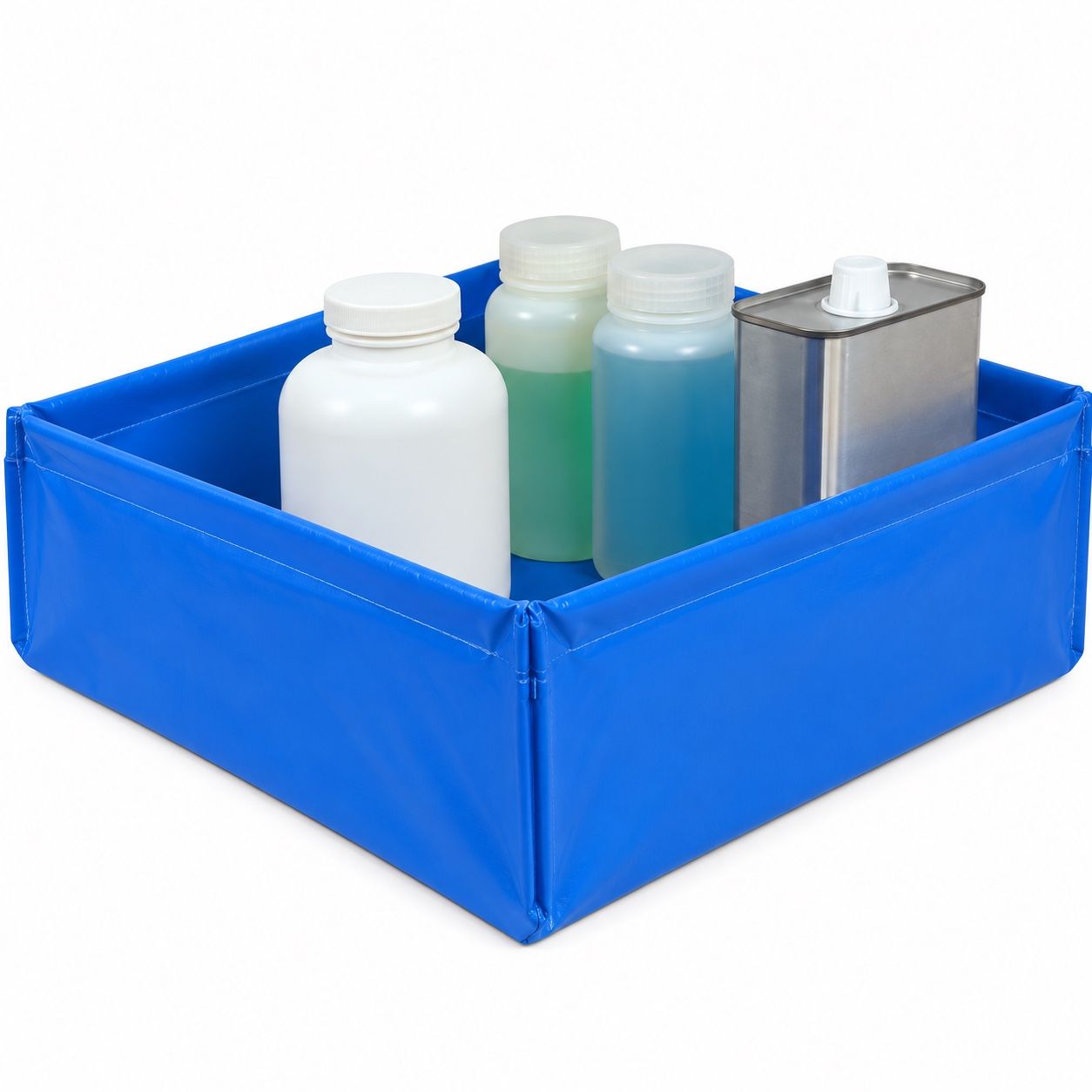
The smallest thing we make, and the simplest. One piece of PVC-coated polyester, folded and welded so the walls stand on their own — no foam, no brackets, no struts, nothing to lose. Unroll it under a leaking part; roll it back into a toolbox afterwards.
- One piece of welded fabric — no foam, no brackets, no struts
- The fold is the structure; unfold it and the walls are up
- Rolls into a toolbox, a spill kit or under a vehicle seat
- Six square sizes from 12 in to 48 in, or made to yours
- Nothing to lose, nothing to assemble, nothing to break
What it is not
This is the bottom of our range and it is easy to order the wrong thing here, in both directions. Being clear costs us nothing and saves you a return.
Not a spill berm
A berm is sized in feet, has a wall held up by something, and is meant to hold the contents of a container. This is sized in inches and meant to catch a drip.
Not a spill deck
A deck has a grating that drums stand on, above the liquid. Here whatever you are containing sits on the floor of the tray, in whatever leaks out of it.
Not a rigid containment tray
We make one of those too — it holds its shape, takes a grating and stays where it is put. This one folds to nothing, which is the entire reason to choose it over that.
Not secondary containment on its own
Nothing this size satisfies a containment volume requirement for a drum or a tote. It is housekeeping, not compliance.
For containment sized to a container or a regulation, start with foam wall spill berms or flexible spill decks. For a tray that stands on its own and keeps containers up out of the liquid, see rigid containment trays.
Features
No structure to speak of
Every other tray and berm we make has something holding the wall up — foam, a bracket, a strut, air. This one has nothing at all. The way the corners are folded and welded is what makes it stand.
That is why it packs to nothing
With no stiffener anywhere in it, the whole tray rolls into a tube you can push into a toolbox. The largest size weighs under two kilos.
Set up in one movement
Unroll, unfold, done. No straps to thread, no legs to fit, no count of loose parts to check back in afterwards.
Sized for the small stuff
Gas cans, oil filters, part-used tins, a leaking gearbox on a bench. The spills that are not big enough for a berm but are still a mess on a floor.
Welded, liquid-tight
PVC-coated polyester, CNC-cut and heat-welded like everything else we build. The fact that it is small does not make it a different product to make.
Sold by the dozen, not the unit
This is a spill kit component and a counter line. It is the cheapest thing in our range to make and the easiest to carry deep stock of.
The fabric is PVC-coated polyester, not a PE sheet. How it is built, and how we weld it.
Sizes
Six squares from a single gas can up to a small engine. Other square sizes are made to order; the shape has to stay square, for the reason in the FAQ below.
| Ref. | Size | Depth | Box volume (upper bound) | Measured capacity |
|---|---|---|---|---|
| ST-12 | 12 × 12 in 305 × 305 mm | 4.8 in 120 mm | 3 US gal 11.3 L | Not yet measured |
| ST-18 | 18 × 18 in 457 × 457 mm | 4.8 in 120 mm | 6.7 US gal 25.5 L | Not yet measured |
| ST-24 | 24 × 24 in 610 × 610 mm | 4.8 in 120 mm | 12 US gal 45.3 L | Not yet measured |
| ST-30 | 30 × 30 in 762 × 762 mm | 4.8 in 120 mm | 18.7 US gal 70.8 L | Not yet measured |
| ST-42 | 42 × 42 in 1067 × 1067 mm | 4.8 in 120 mm | 36.7 US gal 138.8 L | Not yet measured |
| ST-48 | 48 × 48 in 1219 × 1219 mm | 4.8 in 120 mm | 47.9 US gal 181.2 L | Not yet measured |
That fourth column is the box, not the tray. A folded tray gathers at the corners and its walls lean inwards, so it holds less than length × width × depth. How much less is decided by the fold, and it varies enormously: of two Western trays we measured at almost the same size, one publishes about half its box volume and the other close to all of it. Borrowing either number would be a guess dressed up as a specification, so the last column stays empty until we have filled one with water.
Specifications
| Product | Flexible spill tray: one-piece folded and welded, no internal support of any kind |
|---|---|
| Construction | PVC-coated polyester, CNC-cut and heat-welded |
| Fabric weight | 18 oz/yd² (610 g/m²) — the convention for this product, and our standard grade |
| Depth | 4.8 in (120 mm) as standard; other depths made to order |
| Shape | Square. The corner fold is what makes the wall stand, and it only works when the sides are equal |
| Sizes | 12, 18, 24, 30, 42 and 48 in square as standard; other square sizes made to order |
| Capacity | The figures in the table above are geometric — the volume of the box, not of the tray We publish measured capacity, not calculated capacity, and this size has not been water-tested yet. If you are sizing to a regulation, ask us before you order and we will tell you exactly where that stands rather than hand you the geometric figure |
| Weight | Given on the quotation for the sizes you ask about — every size is cut to order, so there is no single figure to publish |
| Colour | Yellow, black, blue, orange and green, at no extra cost and with no separate minimum — the colour is a choice of fabric roll, not a pigment batch, so changing it costs us nothing and we do not charge for it |
| Liquids | Send the Safety Data Sheet so the fabric can be checked before you order |
| Cleaning | Unfolds flat to be wiped or hosed down, then rolls again |
| Branding | Private label and custom packaging for OEM orders |
| MOQ | 20 units per size. That is low for made-to-order containment, and it is deliberate: a distributor should be able to test a size on a real order rather than commit to a container of it |
| Lead time | Production takes 15 working days for up to 50 units and 25 working days for 50 to 200. Above 200 units we schedule it with the order. The clock starts when your deposit reaches us, not when the order is placed |
| Samples | Samples take 5 working days. We charge for the sample — the amount depends on the size, so it is quoted with your request — and we refund that charge against your first production order. Sample freight is on the buyer |
| Packing | Every size packs differently, so there is no single carton spec worth publishing. Folded size, carton dimensions and gross weight go with the quotation for the sizes you are ordering — before you commit to freight, not after |
How to order
- Pick the sizes and the quantity per size — this is a line people buy deep, not one at a time.
- Say what it is catching and send a Safety Data Sheet if the liquid is unusual.
- Send your branding if they are going into your own spill kits.
- Production and shipment from our factory in Taizhou, Zhejiang, China.
For distributors
Of everything on this site, this is the item with the lowest unit price and the highest repeat rate. It goes into spill kits, onto counters and into vehicle glove boxes, and it gets thrown away and replaced rather than repaired.
It is also the cheapest thing here to carry your name on. A berm gets bought once every few years; a printed tray sits in front of an end user every week.
Questions about flexible spill trays
What is a flexible spill tray?
A small square tray made from one piece of coated fabric, folded and welded so that the walls stand up on their own. There is no foam, no bracket and no frame in it. Unroll it and unfold it and it is ready; roll it up and it goes back in a toolbox.
Why does it hold less than the dimensions suggest?
Because a folded tray is not a box. The corners gather and the walls lean inwards, so the space inside is less than length × width × depth. How much less depends entirely on how the corners are folded — we have measured two Western products of almost the same size where one holds about half its box volume and the other nearly all of it. That is why we will publish a measured figure for ours rather than a calculated one.
Why does it have to be square?
The corner fold is what makes the wall stand, and it only balances when the sides are equal. Make it long and thin and the long walls have nothing holding them. If you need a rectangle, tell us the size and we will say whether it can be folded or whether you want a small foam wall berm instead.
Does it stay open on its own, or does it need something in it?
It stands on its own once unfolded. What it will not do is resist something knocking it — put a boot against the wall of an empty one and it will fold in. That is the trade for having no structure in it at all.
Can it be washed out and reused?
Yes. It unfolds completely flat, which is the point of the design — wipe or hose it, let it dry and roll it again. There are no seams behind a bracket or a foam sleeve where residue can sit.
Does this count as secondary containment?
No, and we would rather say so. A tray this size does not hold the contents of a drum, so it does not satisfy a containment volume requirement under the US container storage rules or their equivalents. It is there to keep drips off a floor. For containment sized to a regulation, start with a berm.
Which liquids can it contain?
PVC-coated fabric handles diesel, lubricating oils and hydraulic fluids well. Some solvents and aromatic chemicals attack PVC. Because this tray is often used for whatever happens to be leaking, tell us the worst case you expect and send its Safety Data Sheet.
Can you print our name on them?
Yes, and on a line like this it is worth doing. These go into spill kits and onto counters in quantity, which makes them one of the cheapest ways to get a distributor’s name in front of an end user repeatedly.
Specifications on this page are confirmed with the factory; anything still marked TBC is a gap we have left visible rather than filled with a plausible number. Checked by the production team at Taizhou Fengxu Textile Industry Co., Ltd. on . How we verify what is on this site.
Quote flexible spill trays
Send the inner size or equipment footprint, the liquid, the quantity and the destination. We reply with a quote by email.