
Vehicle containment berms · Stay-braced sides, foam ends
Drive-through spill berms
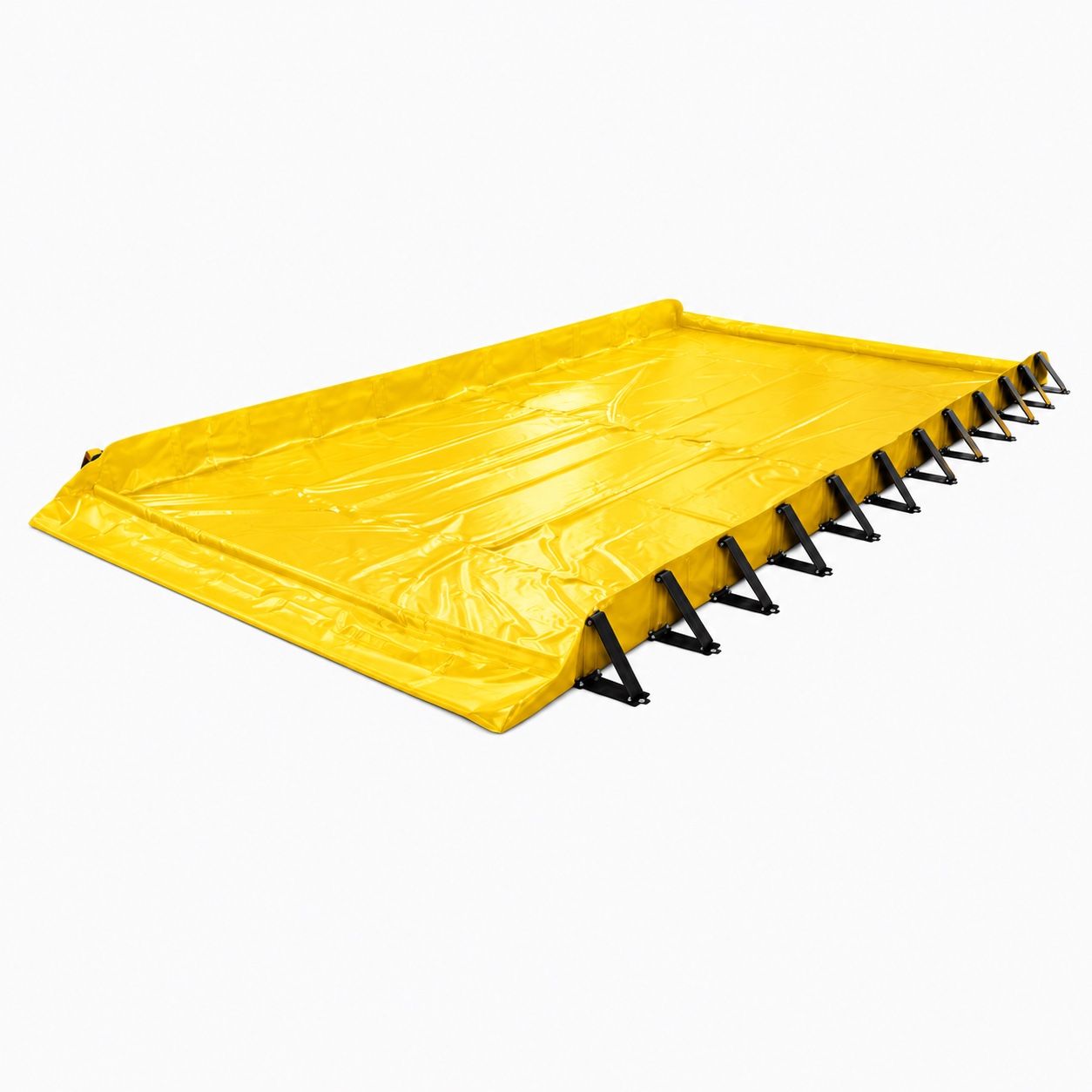
A tanker-scale containment berm you drive into and out of without changing anything. The two long sides are rigid walls braced by triangular stays; the two ends are foam walls that lie flat to be crossed and float up when liquid reaches them. Made to size in our Taizhou factory for OEM and private-label distributors in the US, UK and Europe.
- Drive in one end and out the other, every time, with nothing to fold
- Foam end walls lie flat, then float up when liquid reaches them
- Long sides braced by attached triangular stays at full wall height
- Built at tanker and equipment scale, from 10 × 16 ft up
- Made to any length and width, OEM and private label
How the foam end wall works
Every other berm we make asks you to do something before a vehicle can get in: step over a foam wall, pull the brackets out, or fold the stays down. This one does not, because the wall a vehicle crosses is not holding itself up in the first place.
The end wall is polyethylene foam sealed inside a fabric cover, welded into the floor. At rest it lies flat on the ground, low enough that a truck wheel rolls over it. It is not braced, hinged or clipped to anything, so there is nothing to set and nothing to get out of adjustment.
When liquid spreads across the floor and reaches the end wall, the foam floats. The wall lifts with the liquid level and holds it back. Nobody has to be there, and nothing has to be switched on.
The long sides are a different wall entirely: full height, held up by triangular stays attached outside the berm. That hardware is the same as on our stay-supported spill berms, and those walls are never meant to be driven over.
What we can tell you, and what we cannot yet
A floating wall raises fair questions. No manufacturer in this market publishes answers to them, so here is exactly where the line is rather than a page of claims.
Confirmed
The mechanism: the foam lies flat, and it floats as liquid reaches it. Set-up happens once, and after that a vehicle crosses the end wall in both directions with nothing to fold or remove.
Not claimed
How fast the wall rises, the slowest leak that will still lift it, how long it holds once up, whether it can be crossed with liquid already inside, and how it behaves in snow and hard frost. We describe the mechanism, not a rise time. Ask us with the leak rate you are planning for and we will tell you what we can stand behind.
If your risk is a slow seep rather than a burst, a rigid-walled type may suit you better — tell us the leak you are planning for and we will say which berm we would quote.
Features
The drive line never changes
Set the berm out once. After that a truck crosses the foam end wall on the way in and again on the way out, as often as the job needs, without anyone dropping a wall or pulling a bracket.
The end wall floats, it does not stand
Polyethylene foam sealed inside a fabric cover lies flat on the ground. When liquid reaches it the foam floats and the wall comes up with the liquid level.
Full-height sides where you want them
The two long sides are rigid walls braced by triangular stays, so the berm keeps its capacity along its length. Only the ends are made to be crossed.
Welded, liquid-tight floor
PVC-coated polyester is CNC-cut and joined by high-frequency or hot-air welding, so there are no stitch holes anywhere in the containment area.
One piece, no loose hardware
Stays and foam ends all stay on the berm. Nothing ships in a second bag and nothing gets left behind at the last site.
Sized to the vehicle
Length follows the truck, the tanker or the string of equipment that has to sit inside it. Send the vehicle dimensions and the clearance you want.
The floor is PVC-coated polyester, not a PE tarp. How the fabric is built, and how we weld it.
Sizes and capacities
This class is built at 12 in (305 mm) walls across the market, and it is not made small — below about 10 × 16 ft a drive-through layout stops earning its keep. Every berm is made to order; the footprints below are the ones Western catalogues are built around, so they are the easiest to compare a quote against.
| Ref. | Inner floor size | Capacity at a 12 in (305 mm) wall |
|---|---|---|
| DT-10x16 | 10 × 16 ft 3050 × 4875 mm | 1,197 US gal 4,531 L |
| DT-10x26 | 10 × 26 ft 3050 × 7925 mm | 1,945 US gal 7,362 L |
| DT-12x30 | 12 × 30 ft 3660 × 9145 mm | 2,693 US gal 10,194 L |
| DT-12x36 | 12 × 36 ft 3660 × 10975 mm | 3,232 US gal 12,233 L |
| DT-12x50 | 12 × 50 ft 3660 × 15240 mm | 4,488 US gal 16,990 L |
| DT-12x60 | 12 × 60 ft 3660 × 18290 mm | 5,386 US gal 20,388 L |
| DT-14x40 | 14 × 40 ft 4265 × 12190 mm | 4,189 US gal 15,857 L |
| DT-14x54 | 14 × 54 ft 4265 × 16460 mm | 5,655 US gal 21,408 L |
| DT-14x84 | 14 × 84 ft 4265 × 25605 mm | 8,797 US gal 33,301 L |
Capacity is geometric: inner floor size × wall height, filled level, before anything is placed inside. Subtract the volume of the vehicle standing in it, and allow for rain outdoors. How much capacity the rules require.
Longer than anything in the table? These berms are sized to the vehicle, so send the truck or tank dimensions and the clearance you want. A berm wider than the fabric roll has a welded seam in the floor. It is welded, never stitched, and tested like the rest of the berm — where your size needs one we tell you how many and where, on the quotation, rather than leaving you to find it on delivery.
Drive-through or stay-supported?
These two share the same side-wall hardware and reach the same long footprints. The question is only what happens at the end the vehicle goes through.
| Stay-supported | Drive-through | |
|---|---|---|
| Getting a vehicle in | Fold the stays on one wall flat, drive in, raise them again — every time | Drive straight over the foam end wall, in and out, with nothing to do |
| End walls | Rigid, stay-braced, same as the sides | Foam sealed in a cover; lies flat and floats up in a spill |
| Long sides | Triangular stays | Triangular stays — the same hardware |
| Smallest size | 4 × 4 ft | Not made small; 10 × 16 ft is where this class starts |
| Choose it when | The berm sits still, or a vehicle enters rarely | A vehicle goes in and out repeatedly and no one will re-rig a wall each time |
Emptying the berm between vehicles matters more than driving through it? Tanker and railcar transfer berms put drain fittings through the wall at floor level so the berm clears without being moved.
Smaller jobs go to foam wall spill berms or L-bracket spill berms. All berm types and fabric weights.
Specifications
| Product | Drive-through spill containment berm: stay-braced long sides, self-rising foam end walls |
|---|---|
| Construction | PVC-coated polyester floor and walls, CNC-cut, high-frequency or hot-air welded |
| Side walls | Triangular stays attached outside the wall — the same hardware as our stay-supported berms |
| End walls | Closed-cell polyethylene foam, sealed inside a welded sleeve. Closed cell, not open cell: a wall that has to stand in standing liquid — and on some of our berms float up in a spill — cannot be a sponge, and a cut in the cover does not turn it into one. It lies flat to be crossed and floats up as liquid reaches it — which is exactly why the cell structure is not a detail |
| Wall height | 12 in (305 mm) as standard for this class; other heights made to order |
| Fabric weight | 18 oz/yd² (610 g/m²) as standard, or 22 oz/yd² (745 g/m²) heavy duty where the ground or the traffic is rough. We also run 40 oz/yd² (1355 g/m²) for rail work |
| Sizes | From 10 × 16 ft, made to order in any length and width. Not built at drum or IBC scale — that is what the other berm types are for |
| Colour | High-visibility yellow with black stays as standard — US catalogues sell this class mainly in black, and we make it either way. Yellow, black, blue, orange and green, at no extra cost and with no separate minimum — the colour is a choice of fabric roll, not a pigment batch, so changing it costs us nothing and we do not charge for it |
| Capacity | Geometric: inner length × width × wall height, level, before anything is placed inside |
| Rise behaviour | The end wall floats as liquid reaches it We describe the mechanism, not a rise time. Tell us the leak rate you are planning for and we will say what we can stand behind. |
| Driving over a full berm | Empty, the foam end wall is made to be driven over. Once liquid is standing against it we do not claim the same, and we would rather say so than have you find out with a full berm under your wheels. |
| Temperature range | Ask us with your climate and your liquid. We would rather check the fabric and the foam against your conditions than publish one range and have you assume it covers a cold store or a desert yard |
| Weight | Stays and foam ends included. Given on the quotation for the sizes you ask about — every size is cut to order, so there is no single figure to publish |
| Folded size | Given on the quotation for the sizes you ask about — every size is cut to order, so there is no single figure to publish |
| Liquids | Send the Safety Data Sheet so the fabric can be checked before you order |
| Options | Drain fitting, ground tarp, track belt, storage bag, replacement stays, repair kit. All of them. Ground tarps, track belts, skirts, carry bags and repair kits are made in our own factory rather than bought in, so they are quoted and shipped with the berm as one order |
| Branding | Private label and custom packaging for OEM orders |
| Quality | Every berm — not a sample — is filled with water and left standing for two hours before packing, signed off by the production manager and given a batch number |
| MOQ | 20 units per size. That is low for made-to-order containment, and it is deliberate: a distributor should be able to test a size on a real order rather than commit to a container of it |
| Lead time | Production takes 15 working days for up to 50 units and 25 working days for 50 to 200. Above 200 units we schedule it with the order. The clock starts when your deposit reaches us, not when the order is placed |
| Samples | Samples take 5 working days. We charge for the sample — the amount depends on the size, so it is quoted with your request — and we refund that charge against your first production order. Sample freight is on the buyer |
| Packing | Every size packs differently, so there is no single carton spec worth publishing. Folded size, carton dimensions and gross weight go with the quotation for the sizes you are ordering — before you commit to freight, not after |
Helps a site meet the secondary containment it has to provide under the US SPCC rule (40 CFR 112) and the container storage rules (40 CFR 264.175), or UK oil storage regulations, when it is sized for what it serves. No containment product is "EPA certified". What the rules actually require.
Where drive-through berms are used
Vehicles that park inside
A truck, tanker or trailer stands in the berm overnight or between jobs, and drives out again without the berm being touched.
Truck and plant parking
Vehicles with a known leak, or parked over a surface that must not be contaminated, on a bay used many times a day.
Long equipment strings
Berms sized around a line of plant or containers, where the containment has to follow the equipment footprint.
Temporary refuelling bays
Where a vehicle rolls in, takes fuel and rolls out again many times a shift. If the berm also has to be drained between vehicles, see tanker transfer berms.
Heavy equipment yards
Excavators, loaders and generators that are tracked or driven into position and out again.
Wash-down water
Collecting general wash-down water where the vehicle drives through rather than being lifted in, usually with a track belt under the wheels.
Catching what a vehicle leaks is one job. Deliberately filling a shallow tray with disinfectant and driving tyres through it is another — for disease control at a farm gate or border post, see vehicle disinfection berms.
Accessories
Ground tarp
Goes under the berm on gravel or rough concrete so stones cannot work through the floor.
Track belt
A wear layer on the drive line, where every wheel crosses the same strip of fabric.
Drain fitting
Lets rainwater or collected liquid out through a hose instead of being pumped.
Replacement stays
A bent stay should not retire a berm this size. Ask for the part to be quoted with the order.
Repair kit
Patch material and adhesive to keep a berm in service after damage.
Storage bag
Keeps a large folded berm together on a truck or in a store room.
Sizes, grades and the welded-in option: ground tarps, track belts and repair kits.
How to order
- Send the vehicle and the site: what drives in, the clearance you want around it, the volume to hold, the liquid, quantity and destination.
- Get a quote by email, with the stay and foam specification, options and packing for your order.
- Approve a sample for new sizes or private-label ranges.
- Production and shipment from our factory in Taizhou, Zhejiang, China.
For distributors
These are the high-value line in a berm catalogue: long, vehicle-scale and specified around a customer's site rather than picked off a shelf. We build them under your brand and packaging, with your own model codes.
Questions about drive-through spill berms
What is a drive-through spill berm?
A vehicle-scale flexible containment berm with two different kinds of wall. The two long sides are rigid walls braced by triangular stays. The two end walls are foam sealed in a cover: they lie flat so a vehicle can drive over them, and they float up when liquid reaches them. The result is a berm a truck can enter and leave repeatedly without anyone changing the berm first.
Is this the same as a self-rising spill berm?
No. A self-rising berm has floating foam on all four walls. This one has foam only on the two ends, where the vehicle crosses; the long sides are rigid stay-braced walls that are never driven over. If you want floating walls all the way round, tell us and we will quote that instead.
What is the difference between this and a stay-supported spill berm?
The end walls. A stay-supported berm has stays on all four sides, so to drive in you fold the stays on one wall flat and raise them again afterwards — every entry. A drive-through berm replaces that wall with a foam one, so the drive line never has to be touched. Everything else, including the side-wall hardware, is the same.
Do I have to do anything before driving through, every time?
No. That is the point of this type. Set the berm out once, and after that a vehicle crosses the foam end wall in and out as often as the work needs. There is nothing to fold, unclip or carry away.
How fast does the foam wall rise in a spill?
The wall floats as liquid reaches it, so it comes up with the liquid level rather than at a fixed speed. No manufacturer in this market publishes a rise-time figure, and we will not invent one. Tell us the leak rate you are planning for and we will say what we can confirm about the foam we use.
What happens if it is a slow leak instead of a sudden spill?
A drip that never builds enough depth to float the foam will pool on the floor inside the berm rather than being held by a raised wall. The floor still catches it, and on a level surface that is usually what you want. If your risk is slow seepage rather than a burst, say so — a rigid-walled type may suit you better.
Can I drive over it while there is liquid inside?
We do not claim that. The long sides are rigid stay-braced walls and are not made to take a wheel at all, and we will not promise the end wall can be crossed with liquid contained until the factory has confirmed it. Treat a berm that has caught a spill as out of service until it is pumped out.
What is the smallest size you make?
This type starts around 10 × 16 ft (3.0 × 4.9 m), which is also where the Western market starts it. Below that the drive-through layout stops making sense: for drums, IBCs, generators and machinery use a foam wall berm, an L-bracket berm or a stay-supported berm instead.
Do you make this for trucks and heavy equipment?
Yes — that is what the long sizes are for. Send the vehicle length and width, the clearance you want around it, and the volume the containment has to hold, and we will quote a footprint from that. If the berm is for a transfer operation and has to be drained between vehicles, our tanker transfer berms carry floor-level drain fittings instead.
What happens in snow or freezing weather?
Cold stiffens coated fabric and foam, and snow or ice sitting on a flat end wall will work against it floating. We have not published a cold-weather rating for this product and will not guess at one. If you are buying for a cold market, say so in your enquiry so the fabric can be specified for it.
Which liquids can it contain?
PVC-coated fabric is commonly used for diesel, lubricating oils and hydraulic fluids. Some fuels, solvents and aromatic chemicals attack PVC. Send the Safety Data Sheet of the liquid so the material can be checked before you order.
Specifications on this page are confirmed with the factory; anything still marked TBC is a gap we have left visible rather than filled with a plausible number. Checked by the production team at Taizhou Fengxu Textile Industry Co., Ltd. on . How we verify what is on this site.
Quote a drive-through spill berm
Send the inner size or equipment footprint, the liquid, the quantity and the destination. We reply with a quote by email.