
Fixed machinery · Bonded to your floor · No floor sheet
Spill containment curbs
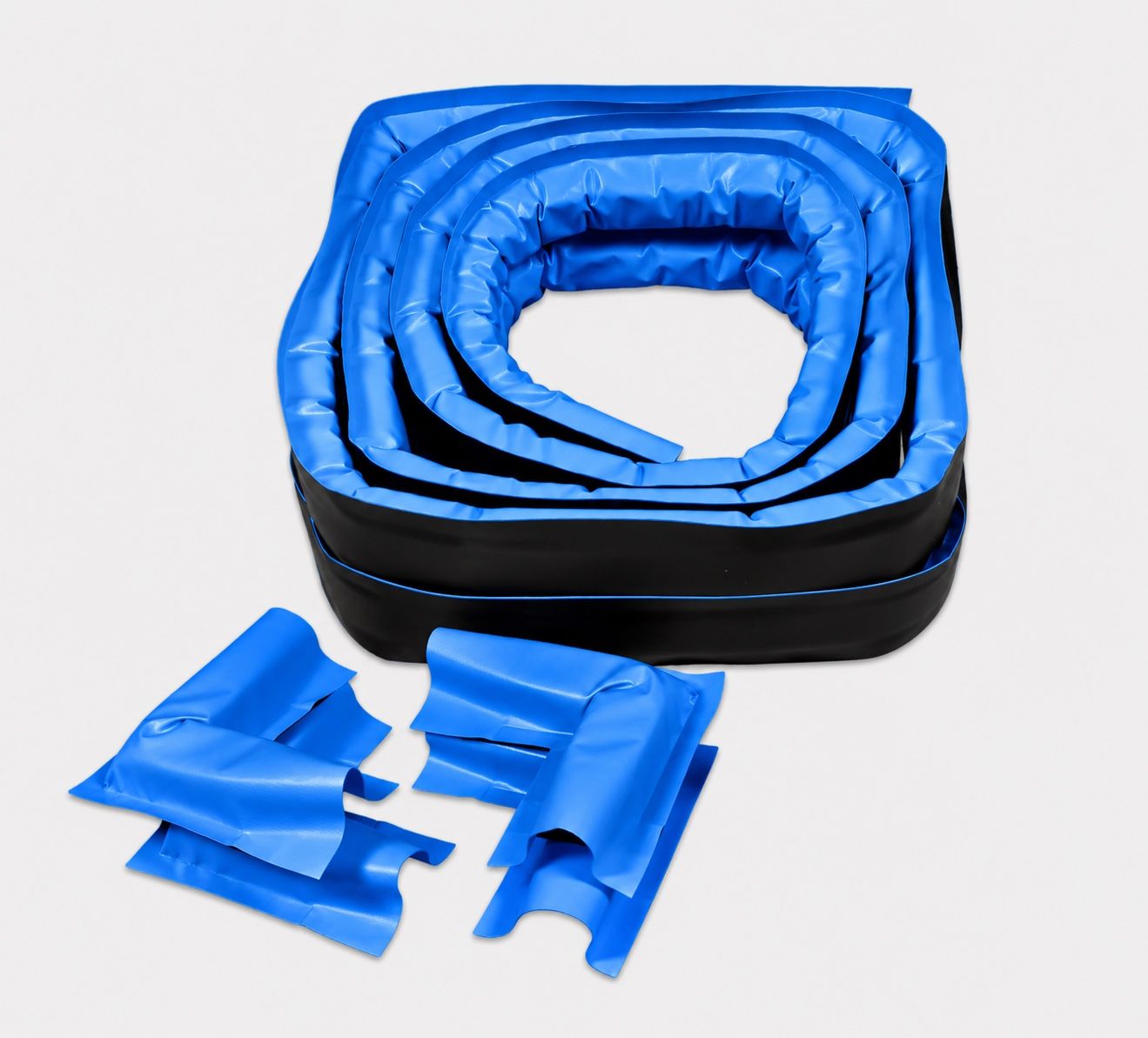
Every other product on this site is a tray you put something into. This one is for the machine you cannot move — bolted down, piped in, or simply too heavy. Foam-cored PVC wall sections bond to the floor you already have and enclose it where it stands. Made in our Taizhou factory for OEM and private-label distributors in the US, UK and Europe.
- Walls off machinery that is bolted down or too heavy to lift
- Glues to the floor you already have — no floor sheet in the kit
- Foam core in a PVC cover, cut to length on site
- 2, 4 and 6 in heights; the shape is whatever you run it in
- Comes up with a flat shovel when the machine is retired
Your floor is the containment, and that changes everything
This is the only product we sell where the surface holding the liquid is not ours. It is worth being blunt about what that means, because the answer decides whether this product works for you at all — and no competitor page we could find says it.
What the rule actually asks for
The US container storage rule requires the base of a containment area to be free of cracks or gaps and sufficiently impervious to contain leaks, spills and accumulated precipitation. The oil rule separately names containment curbs as an accepted method — so the wall is not the issue. The floor is.
EPA's own inspection guidance goes further and singles out the joint between the wall and the floor as a place to check for permeability. On this product, that joint is the entire design.
What that means in practice
On sound concrete that has been sealed or coated, a bonded curb is a real containment boundary and a far cheaper one than pouring a kerb or bolting down angle iron.
On bare, porous, oil-soaked or cracked concrete, it is not — and it was not before we arrived either. A wall around a slab that leaks gives you a wall and no floor. No supplier's wall section fixes that.
So check the slab first. If it needs sealing or coating, that is a separate job and it has to happen before the curb goes down. We would rather tell you that now than after you have bought a kit.
If the floor cannot be made good, the honest answer is a product that brings its own floor — one of our berms or a spill deck — even if that means moving the equipment after all. How containment volume is worked out.
What is in the kit
Wall sections
Lengths of foam core in a welded PVC cover, cut on site to the run you need. High-visibility so nobody trips on it.
Corners and ends
Preformed pieces so the turns and terminations are a fitted part rather than a folded guess.
Connector collars
Joins one length to the next in a continuous run, instead of butting two cut ends together and hoping.
Floor sealant
Beds the wall to the slab and closes the line where the two meet. On this product that line is the whole containment.
Seam adhesive
Bonds section to section so the wall behaves as one piece rather than a row of separate bits.
Nothing underneath
There is no floor in this kit, by design. Your slab is the floor — which is why the section below matters more than anything else on this page.
The wall is the same foam-in-a-welded-cover build as our foam wall spill berms — the difference is that one comes attached to a floor and this one does not.
Heights, and how the volume works out
There is no size table on this page, because the product has no size — you run it in whatever shape the machine needs. What you choose is the height, and the volume follows from the area you enclose.
| Curb height | Contained volume around a 10 × 12 ft machine |
|---|---|
| 2 in (51 mm) | 150 US gal 566 L |
| 4 in (102 mm) | 299 US gal 1,133 L |
| 6 in (152 mm) | 449 US gal 1,699 L |
The arithmetic is just enclosed area × height, worked here on a 10 × 12 ft footprint as an illustration. Use your own area and subtract whatever the machine itself stands on. Send us the layout and the volume you have to hold and we will tell you the height and the run length. 2, 4 and 6 in (50, 100 and 150 mm) as standard, with other heights made to order. Given on the quotation for the sizes you ask about — every size is cut to order, so there is no single figure to publish.
Specifications
| Product | Spill containment curb (UK: kerb) — a component wall system bonded to an existing floor |
|---|---|
| Construction | Closed-cell polyethylene foam, sealed inside a welded sleeve. Closed cell, not open cell: a wall that has to stand in standing liquid — and on some of our berms float up in a spill — cannot be a sponge, and a cut in the cover does not turn it into one, in a welded PVC cover — the same wall build as our foam wall berms |
| Heights | 2, 4 and 6 in (50, 100 and 150 mm) as standard; other heights made to order |
| Length | Supplied in lengths and cut to the run on site with a knife; corners and ends are preformed |
| Base width | The foot is wider than the wall is tall, because a bonded curb needs the bonding area. Given on the quotation for the sizes you ask about — every size is cut to order, so there is no single figure to publish |
| Temperature range | Ask us with your climate and your liquid. We would rather check the fabric and the foam against your conditions than publish one range and have you assume it covers a cold store or a desert yard |
| Floor | Not supplied. Your slab is the containment base — see the floor section above |
| Fabric | The same PVC-coated polyester we weld into berms, in the same three grades |
| Foam | Closed-cell polyethylene, the same core as our berm walls |
| Colour | High-visibility yellow as standard, because a curb people walk over should be seen. Yellow, black, blue, orange and green, at no extra cost and with no separate minimum — the colour is a choice of fabric roll, not a pigment batch, so changing it costs us nothing and we do not charge for it |
| Sealant and adhesive | Bought-in chemical products, not something we manufacture Construction adhesives and sealants are restricted in air and sea freight, so assume the kit ships without them and that you buy locally to our specification. Ask us before you plan around shipping them with the order. |
| Removal | The wall lifts with a flat-bladed shovel. What the sealant leaves behind depends on the sealant and on your floor finish, so ask its supplier before you bond anything to a floor you care about |
| Forklift traffic | A curb is designed for foot traffic. If pallet trucks or forklifts will cross it, tell us where and how often — that changes which height we would recommend, and it may mean a curb is the wrong product for that run. |
| Liquids | Send the Safety Data Sheet so the cover and the sealant can both be checked |
| Branding | Private label and custom packaging for OEM orders |
| MOQ | 20 units per size. That is low for made-to-order containment, and it is deliberate: a distributor should be able to test a size on a real order rather than commit to a container of it |
| Lead time | Production takes 15 working days for up to 50 units and 25 working days for 50 to 200. Above 200 units we schedule it with the order. The clock starts when your deposit reaches us, not when the order is placed |
| Samples | Samples take 5 working days. We charge for the sample — the amount depends on the size, so it is quoted with your request — and we refund that charge against your first production order. Sample freight is on the buyer |
How to order
- Send the layout: the footprint you need to enclose and the run length around it.
- Tell us the floor: bare concrete, sealed, coated, or something else. This decides whether the product is right at all.
- Say the volume you have to hold, and we will work back to the height.
- Check the adhesive question — it may have to be bought locally rather than shipped.
For distributors
This is the answer to a question customers ask constantly and most catalogues have nothing for: containment around equipment that cannot be moved. It sells against pouring concrete, not against another berm, so it is priced and judged differently.
It is also a consultative sale rather than a shelf item — the floor has to be assessed and the run measured, which is work an importer can charge for and a web shop cannot do.
Questions about containment curbs
What is a spill containment curb?
A low wall bonded to a floor to enclose an area, so that a leak stays inside it instead of running across the plant. It is the flexible equivalent of pouring a concrete curb or bolting down angle iron, and it is used where the machine cannot be lifted into a tray. In the UK the same thing is spelled kerb.
Why would I use this instead of one of your berms?
Because you cannot get the machine into a berm. Everything else we make is a tray you put something in. A press, a compressor, a transformer or a machining centre that is bolted to the floor is not going anywhere, so the containment has to be built around it where it stands.
Will it stick to my floor?
To sound, clean, dry concrete, yes. To a slab that is oily, dusty, damp, flaking or unsealed, not reliably — and more importantly, a floor in that condition is not a containment base in the first place. Get the slab checked before you order, not after.
My concrete is cracked. Does that matter?
Very much, and it is the question most suppliers avoid. The US rules for container storage require the base of a containment area to be free of cracks and gaps and sufficiently impervious to hold what is spilled on it. A curb around a cracked slab gives you a wall and no floor. Seal or coat the concrete first, or the wall is decoration.
How do I work out the volume it contains?
Multiply the enclosed floor area by the curb height. There is no capacity table on this page because the shape is whatever you run it in — it is your layout, not our product size, that decides the number.
Does it come up again without wrecking the slab?
The wall itself lifts with a flat-bladed shovel. What the sealant leaves behind depends on the sealant and on the floor, and that is a question for whoever supplies it. Ask before you install it somewhere the floor finish matters.
Is the foam open cell or closed cell?
Closed cell, and it is worth knowing that the best-known product in this category goes the other way. Open-cell foam is softer and springs back a little better after somebody walks over it. Closed cell cannot absorb anything, so if the cover is ever cut — and on a curb bonded to a floor that people cross, eventually one will be — the wall does not quietly turn into a sponge holding the liquid it was supposed to stop. We would rather have the firmer wall that stays a wall. It is also the same core as our berm walls, which keeps one material and one weld process across the range.
Can a forklift or pallet truck drive over it?
A curb is a wall, not a ramp. Crossing it repeatedly with hard wheels will damage it, and at 4 or 6 in high it is a trip hazard as well. If a route has to cross the line, design a gap and a removable section into the layout rather than driving over it.
Do the sealant and adhesive come with it?
That depends on whether they can be shipped to you. Construction adhesives and sealants are regulated in transport and many cannot travel by air or sea freight. Where that applies we ship the wall components and specify exactly what to buy locally, which is usually cheaper and always faster than waiting on a dangerous goods shipment.
Which liquids can it hold back?
The PVC cover handles diesel, lubricating oils, coolants and hydraulic fluids well, and some solvents attack it. Remember that the sealant has its own chemical compatibility, separate from the wall. Send the Safety Data Sheet and both get checked.
Specifications on this page are confirmed with the factory; anything still marked TBC is a gap we have left visible rather than filled with a plausible number. Checked by the production team at Taizhou Fengxu Textile Industry Co., Ltd. on . How we verify what is on this site.
Quote a containment curb run
Send the inner size or equipment footprint, the liquid, the quantity and the destination. We reply with a quote by email.