
Ground tarp · Ground tarp plus · Track belt · Repair kit
Spill berm accessories
Protect the berm floor from stones underneath, protect the drive line from tyre wear above, and keep a puncture repair on the shelf. Cut to the size of your berm rather than sold in fixed stock lengths, from the same PVC-coated polyester as the berms themselves.
- Ground tarp under the berm, track belts on the drive line
- Cut to your berm footprint, not sold in fixed stock lengths
- Same PVC-coated polyester as the berm itself
- Can be welded to the berm so nothing gets left behind
- Repair kit and tape so a puncture does not retire a berm
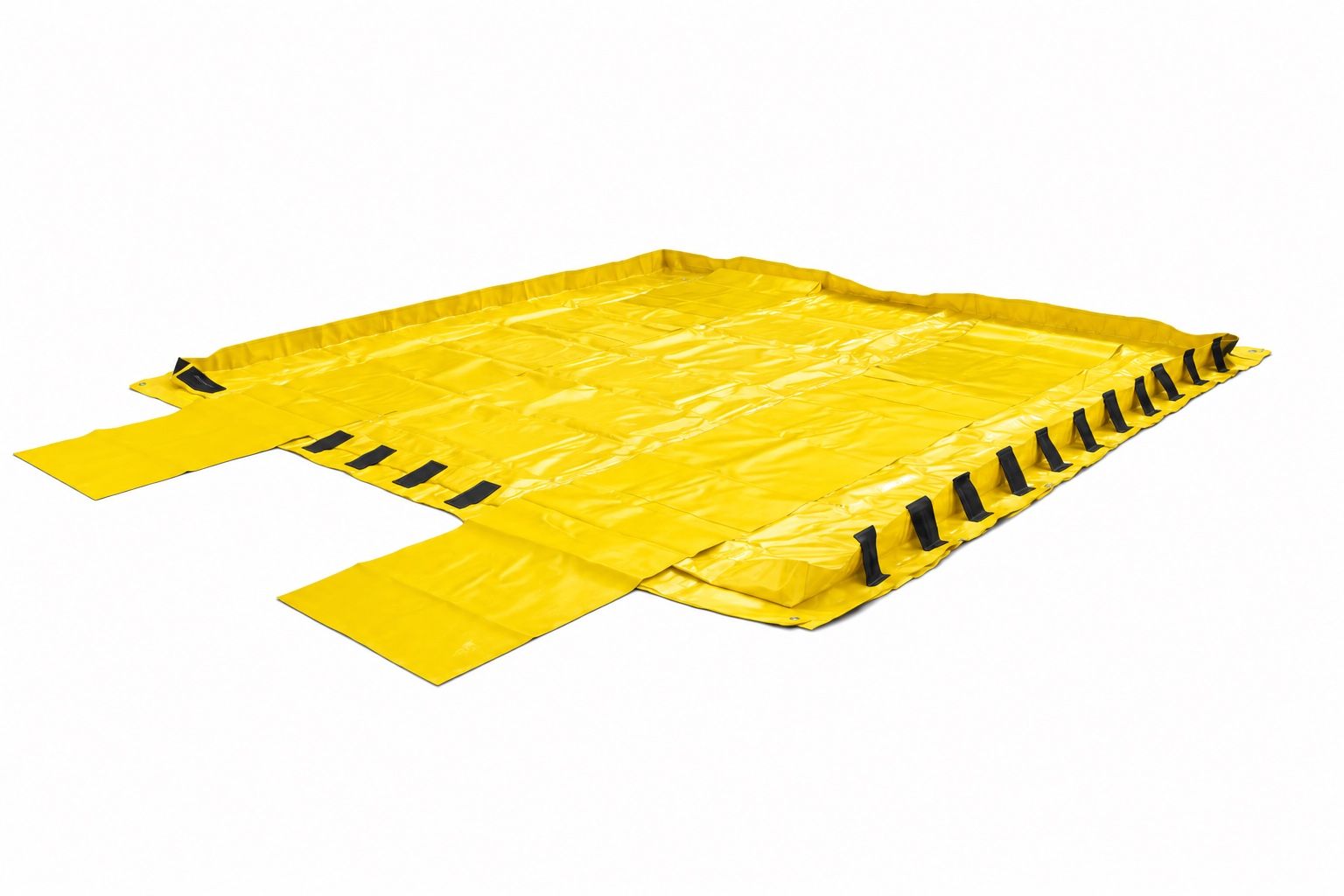
Why a berm gets damaged, and what stops it
A containment berm almost never fails at the weld. It fails because something underneath it cut through the floor, or because the same tyre crossed the same strip of fabric a few thousand times. Both are cheap to prevent and expensive to ignore.
Ground tarp
A plain welded sheet of the same PVC-coated polyester as the berm floor, laid down before the berm goes out. It takes the punishment from stones, gravel and site debris so the berm floor does not. Grommeted, it also gives you something to stake or weigh down.
Ground tarp plus
The heavy version for oilfield and rocky ground, where the standard tarp would still be cut through. Competitors also build an absorbent top layer into this grade for nuisance drips.
Track belt
Strips that lie inside the berm on the line the wheels take, so tyres wear the belt instead of the containment floor. Always a pair — one per wheel track — and run the usable length of the berm.
Welded in, not loose
Tarp and belts can be welded to the berm at the factory so the set arrives as one piece. Nothing to match up on site, nothing to leave behind at the last job.
Repair kit
Patches, adhesive and the tools to put them on. A puncture in a welded PVC floor is a field repair, not a write-off, provided the kit is on the shelf before it is needed.
Repair tape
For the damage that is too small to justify a patch and too real to ignore. Sold by the roll in two widths.
All of it is cut and welded from the same PVC-coated polyester as the berms themselves, so a patch, a tarp and a berm floor are the same material.
What size to order
Accessories are sized from the berm, not from a catalogue. Find your berm footprint and the tarp and belt sizes follow from it.
| Berm footprint | Ground tarp | Track belts |
|---|---|---|
| 4 × 6 ft | 11 × 11 ft | 6 ft, pair |
| 6 × 6 ft | 11 × 11 ft | 6 ft, pair |
| 10 × 10 ft | 11 × 11 ft | 10 ft, pair |
| 12 × 12 ft | 16 × 16 ft | 12 ft, pair |
| 12 × 50 ft | 16 × 54 ft | 50 ft, pair |
| 14 × 54 ft | 18 × 58 ft | 54 ft, pair |
| 14 × 84 ft | 18 × 88 ft | 84 ft, pair |
The rule behind the table. Berms up to 10 × 10 ft take one 11 × 11 ft tarp. Above that, the tarp runs 2 ft past the berm on every side, so the berm can be placed squarely without ending up half off the tarp. That margin is the more generous of the two conventions we found across Western manufacturers — we would rather quote you a tarp that is definitely big enough.
Track belts on small berms. A pair of belts needs floor to sit on. On the smallest foam wall berms — 2 × 2 or 3 × 3 ft — two belts of normal width would cover the whole floor, which defeats the point. Below about 4 ft wide, ask us before adding belts to the order.
Berm footprints come from the product pages: foam wall, L-bracket, stay-supported, drive-through and tanker transfer.
Cut to length beats the nearest stock size
Distributors sell track belts off a fixed ladder of lengths — 20 ft, 26 ft, 30 ft and so on — so a buyer with a 28 ft berm either pays for 30 ft or makes do with 26 ft. That ladder exists because a warehouse has to stock something, not because it suits the berm.
We cut from the roll for the order, so a belt is the length of the berm it is going into. The same is true of tarps: a non-standard berm footprint gets a tarp cut to match it, not the next size up.
For distributors this cuts the other way too — you can carry a range of berm sizes without carrying a matching ladder of accessory SKUs, because the accessories are quoted with the berm.
Welded in, or loose?
Loose is the normal way: the tarp, the belts and the berm arrive as separate items and the crew lays them out in order. It is flexible, and it is cheaper.
Welded in means the tarp and belts are built into the berm as we make it, so the whole assembly unfolds as one piece. It costs more and it fixes the layout permanently — but for a berm that gets struck and re-deployed by different crews, the part that gets lost is always the loose accessory, and this removes that failure entirely.
It has to be decided at quote stage, because it changes how the berm is built rather than being a line added to the order.
There is a third form, and it is different enough to be worth its own section below: the skirt.
The skirt: protection and anchorage in one
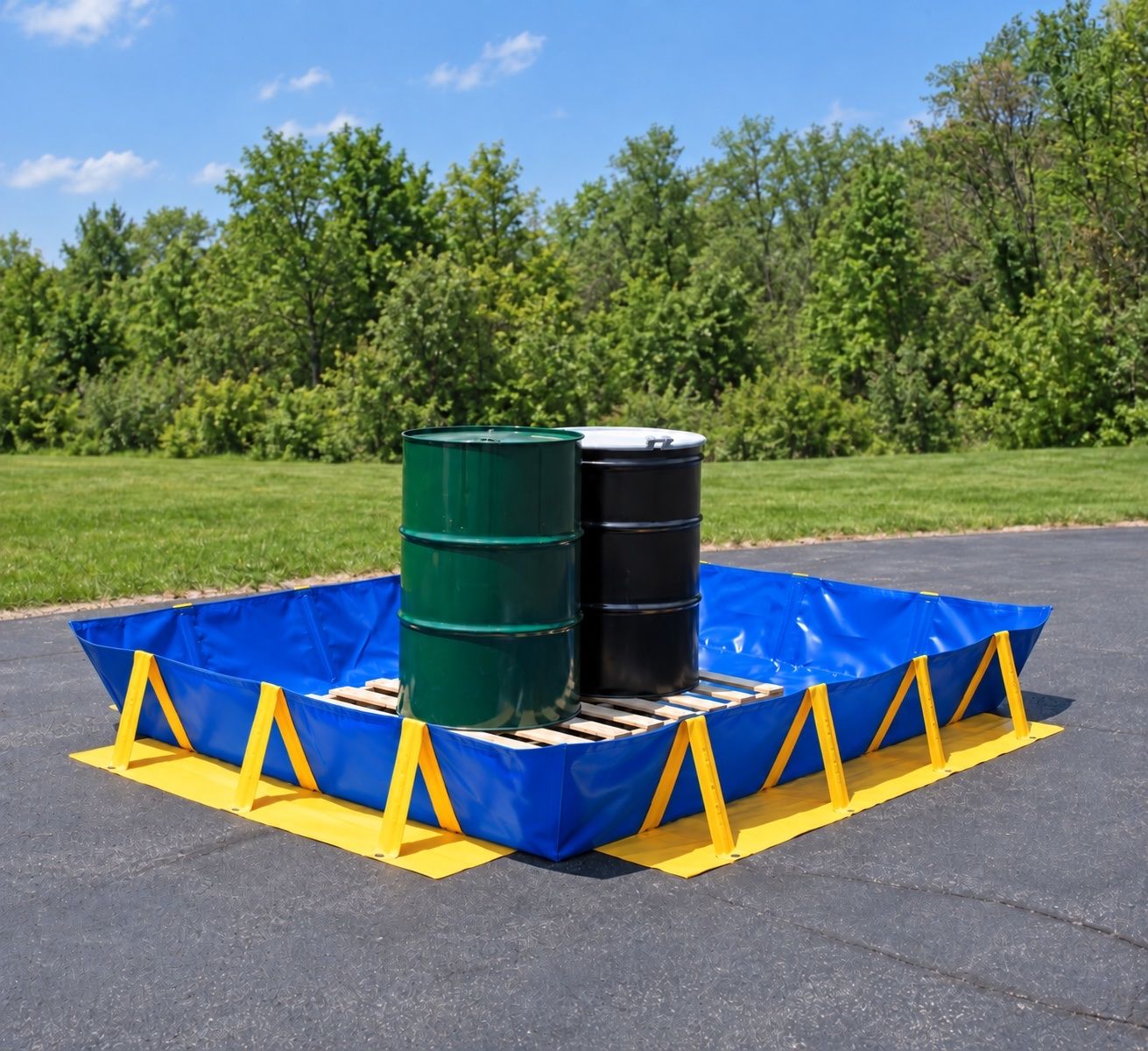
A skirt is a band of fabric welded to the outside of the wall that lies flat on the ground all the way round. It replaces a separate tarp at the wall line, and it solves a problem a tarp does not: how to hold an outside-braced berm down when it is empty and the wind gets under it.
Why it matters outdoors
A berm with its walls braced from outside is stable once there is liquid in it. Empty, on an exposed yard, it is a large flat sheet with walls — and that is when it moves. The skirt is what you stake through or lay sandbags on, so the berm stays where it was put between jobs.
It also takes the wear at the one line that gets it worst: where the wall meets the ground and boots, wheels and plant pass closest.
What we need to confirm
A skirt is welded on as the berm is built, so it has to be specified at quote stage rather than added later, and the width is a real decision — too narrow and there is nowhere to put a sandbag, too wide and it is fabric you are paying to ship.
Yes, at the width your anchoring method needs, with grommets set to match.
Specifications
| Ground tarp material | PVC-coated polyester, the same family as our berm floors. Our grades run 18 oz/yd² (610 g/m²), 22 oz/yd² (745 g/m²) and 40 oz/yd² (1355 g/m²) |
|---|---|
| Ground tarp sizing | Berms up to 10 × 10 ft take a single 11 × 11 ft tarp. Above that we cut the tarp 2 ft past the berm on every side |
| Ground tarp plus | For rocky ground we cut the tarp from our heaviest grade, ${fabricSpec('Rail')} — the same fabric we use for rail units |
| Track belt width | Western belts run between 30 and 36 in wide; there is no single industry standard |
| Track belt length | Cut to the usable length of the berm it goes in. Add a few feet at each end if the end walls are to be covered too |
| Track belt quantity | Sold in pairs, one strip per wheel track |
| Welded-in option | Tarp and belts heat-welded to the berm so the set cannot be separated |
| Skirt | A band of fabric welded to the outside of the wall, lying flat on the ground; the brace stands on it and it is what you stake or weigh down |
| Grommets and tie-downs | Fitted to tarps and skirts, spaced to the size of the piece and to how you intend to anchor it. Tell us whether you are staking or weighting and we will set them accordingly |
| Repair kit contents | Patches in our own fabric, cut to the sizes you want to stock, plus repair tape. The patch is heat-welded on, the same join we use in production, so there is no adhesive to ship or to expire |
| Repair tape | Cut to the widths and roll lengths you want to stock |
| Colour | High-visibility yellow as standard. Yellow, black, blue, orange and green, at no extra cost and with no separate minimum — the colour is a choice of fabric roll, not a pigment batch, so changing it costs us nothing and we do not charge for it |
| Weight | Tarp and belt pair listed separately. Given on the quotation for the sizes you ask about — every size is cut to order, so there is no single figure to publish |
| Branding | Private label and custom packaging for OEM orders |
| MOQ | 20 units per size. That is low for made-to-order containment, and it is deliberate: a distributor should be able to test a size on a real order rather than commit to a container of it |
| Lead time | Production takes 15 working days for up to 50 units and 25 working days for 50 to 200. Above 200 units we schedule it with the order. The clock starts when your deposit reaches us, not when the order is placed |
| Samples | Samples take 5 working days. We charge for the sample — the amount depends on the size, so it is quoted with your request — and we refund that charge against your first production order. Sample freight is on the buyer |
How to order
- Tell us the berm: the footprint, and whether it is one of ours or another manufacturer's.
- Tell us the ground: workshop floor, yard, gravel or oilfield decides which tarp grade to quote.
- Say loose or welded in, because welded-in changes how the berm is built.
- Add the repair items — a kit on the shelf is worth more than a kit ordered after the puncture.
For distributors
Accessories are the repeat line in a berm catalogue. A berm sells once every few years; tarps, belts, patches and tape sell again every time a site chews one up. They are also light, flat and cheap to ship, which makes them easy to add to a container that is already going out.
Questions about berm accessories
What is a ground tarp for a spill berm?
A plain sheet of coated fabric that goes on the ground before the berm is unfolded on top of it. Its job is to be the layer that stones, gravel and site debris cut into, instead of the berm floor. It is the cheapest insurance there is on a berm that costs many times more.
What is the difference between a ground tarp and a ground tarp plus?
Weight and toughness. The standard tarp handles ordinary yard and workshop floors. The plus grade is for oilfield and rocky ground where the standard one would still be cut through, and competitors also build an absorbent top layer into that grade to catch nuisance drips.
What is a track belt?
A strip of heavy coated fabric that lies inside the berm along the line a vehicle wheel takes. The tyre runs on the belt rather than directly on the containment floor, so the wear happens to a part that is cheap to replace. Track belts come in pairs, one per wheel track.
Is a track belt the same thing as a track mat?
They describe the same accessory, but we say track belt. It is the term UltraTech and several independent distributors use as the generic name, and it stays clear of a competitor product name that is spelled very similarly to "track mat".
What size ground tarp do I need for my berm?
For a berm up to 10 × 10 ft, a single 11 × 11 ft tarp covers it with room to place the berm squarely. Above that size, we cut the tarp 2 ft past the berm on every side, so a 12 × 50 ft berm takes a 16 × 54 ft tarp. The margin is there so the berm does not end up half on and half off the tarp.
How many track belts do I need for one berm?
Two, one under each wheel track, for one vehicle driving in and out on a single line. If the berm is wide enough for vehicles to enter on more than one line, or a trailer tracks differently from the tractor, say so and we will quote the number of belts that actually covers it.
Can the tarp and track belt be cut to a custom size?
Always. We are a factory, not a distributor working from a fixed stock ladder, so a belt is cut to the usable length of the berm it is going into rather than rounded to the nearest stock length. The same applies to tarps for non-standard berm footprints.
Do I need a ground tarp under every spill berm, or only on rough ground?
Only rough or unknown ground really needs one. On a clean workshop floor a tarp mostly buys you a cleaner pack-down. Outdoors, on gravel, hardcore or a yard that has had plant on it, treat it as necessary rather than optional.
Will these fit a berm from another manufacturer, or only yours?
A loose tarp or belt is just a cut sheet, so it will work under or inside anyone’s berm as long as you give us the berm size. The welded-in option is different: that is built into a berm as we make it, so it only applies to berms we supply.
Can the tarp and track belt be welded to the berm so they cannot be lost?
Yes, and for berms that move between sites it is worth it. A tarp and a pair of belts that live in a separate bag are the parts that get left behind; welded in, the set arrives and stays as one piece. Tell us at quote stage, because it changes how the berm is built rather than being an item added to the order.
How do I repair a puncture in a PVC berm floor?
Clean and dry the area, then apply a patch of the same fabric, either with adhesive or by heat-welding it down with a hot air gun and a roller. It is a field repair that a site crew can do. What matters is having the kit before the puncture, not after it.
Specifications on this page are confirmed with the factory; anything still marked TBC is a gap we have left visible rather than filled with a plausible number. Checked by the production team at Taizhou Fengxu Textile Industry Co., Ltd. on . How we verify what is on this site.
Quote tarps, belts and repair items
Send the inner size or equipment footprint, the liquid, the quantity and the destination. We reply with a quote by email.