
Holds its shape · Removable grating · Any footprint
Rigid containment trays
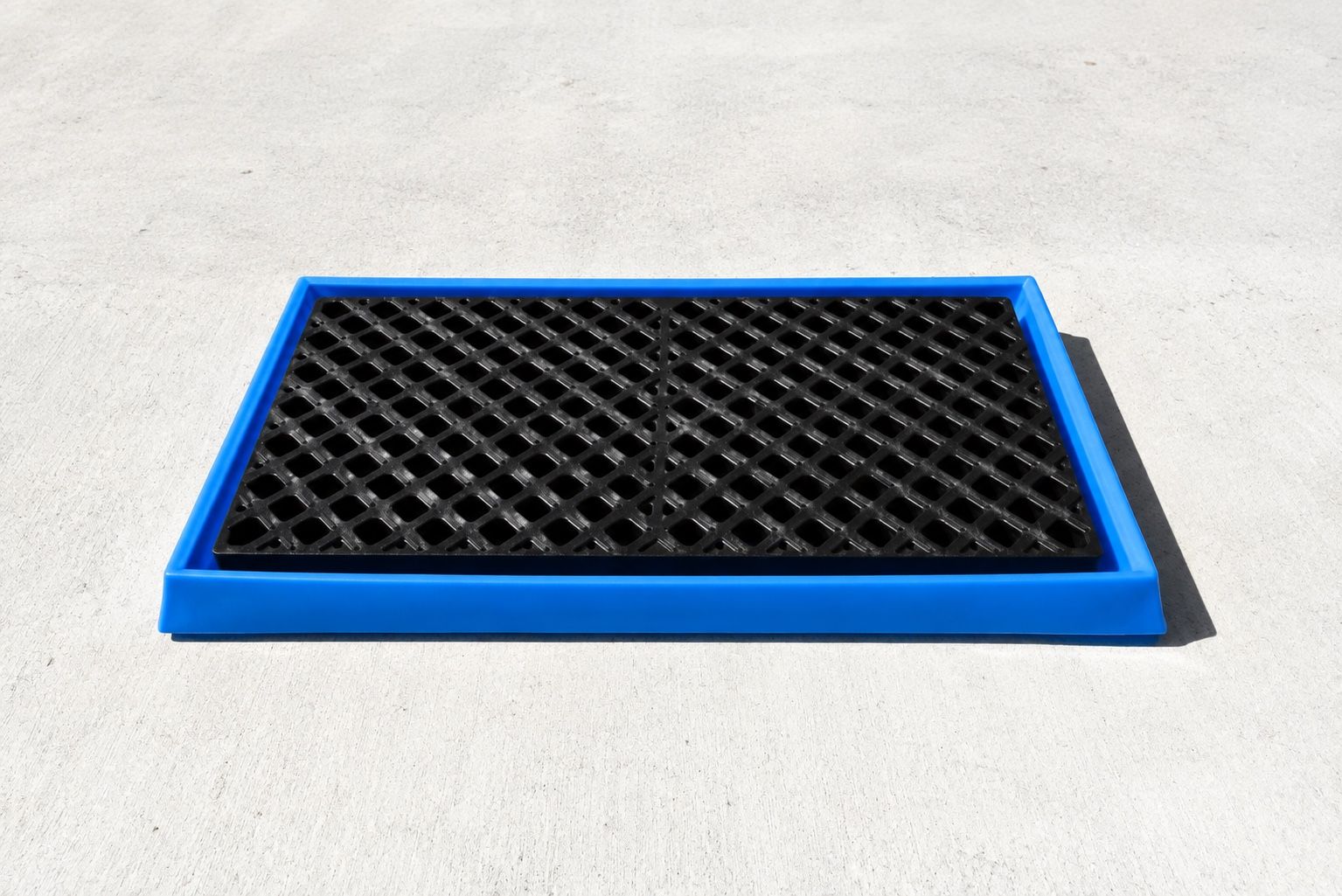
A shallow tray that stays open on its own, with a grating across it so drums, pails, batteries and machine parts stand above whatever leaks out of them. Built as a welded PVC skin over an HDPE structure, which means the size is yours to choose — there is no mould to be locked into.
- Holds its shape empty — nothing to unfold, nothing to prop up
- Removable HDPE grating so containers stand clear of what leaks
- PVC-coated skin over an HDPE structure, both made in our factory
- Any size: there is no mould, so a new size is a cutting program
- Low profile — a pail or a hand truck goes over the edge, not around it
Why the grating, and not just a tray
The obvious version of this product is a shallow box that catches drips. The grating is what turns it from housekeeping into something an inspector recognises.
The US rule for hazardous-waste container storage, 40 CFR 264.175(b)(2), is written as an either/or:
The base must be sloped or the containment system must be otherwise designed and operated to drain and remove liquids resulting from leaks, spills, or precipitation, unless the containers are elevated or are otherwise protected from contact with accumulated liquids.
A concrete pad takes the first route: slope it, collect what runs off, pump it out. A tray with a grating takes the second. The container never stands in its own spill, so nothing has to be drained on a schedule and a drum does not sit rusting in a puddle between inspections.
That paragraph is a RCRA standard for permitted hazardous-waste container storage areas, so whether it binds your site depends on what you store and under which programme — and a tray this size does not, on its own, satisfy the separate volume requirement in (b)(3). We are not going to tell you a drip tray makes a facility compliant. What it does is answer the part of the rule about contact with accumulated liquid, cleanly, at the scale of a bench or a corner of a workshop.
No containment product is “EPA certified”, ours included. The agency regulates facilities and operators, not equipment — what a tray can do is help a site meet a duty it already has.
What it is not
We now make four things that catch liquid under containers, and they are easy to mix up. Here is the short version of each boundary.
Not a flexible spill tray
The folded one rolls into a toolbox and has no structure at all. This one will never fold. Choose by whether it has a permanent place to stand.
Not a flexible spill deck
A deck is sized in drums and folds flat when the grating comes out, which is how a distributor stocks fifty of them in one bay. Take that away and you are buying this instead.
Not a spill pallet
A pallet is deeper, and sized to hold the whole contents of the drum standing on it. This is a low tray for drips, and it is not a compliance volume on its own. We do make the deep kind — in fabric, so it still folds.
Not a berm
A berm is sized in feet, has walls a vehicle or a person steps over, and contains the contents of what stands in it.
Features
The grating is the point
Lift it out and you have a shallow welded tray. Put it back and the pails, cans and batteries sit above the floor of that tray, so a leak from one of them does not sit around the base of the others.
Rigid on purpose
Everything else we make folds. This does not, and that is the trade you are buying: it stays open and square with nothing in it, takes a boot against the wall, and a drum can be walked onto it rather than lifted in.
PVC skin, HDPE structure
The liquid-tight layer is the same PVC-coated polyester we weld into berms. The shape underneath it is HDPE, cut and fabricated here. Two materials, one factory, one part number.
No mould means no size limit
Rotationally moulded trays are locked to the tool they were made in. Ours are cut from sheet, so 54 × 30 in and 61 × 33 in cost the same to set up. Send the footprint you actually need.
A cut can be repaired
A cracked moulded tray is scrap. A cut in a welded PVC skin takes a patch and adhesive, which matters when the tray lives on a workshop floor for ten years.
Your colour, your label
The skin is a coated fabric, so colour is a roll choice rather than a pigment batch, and printing goes straight onto it.
The skin is PVC-coated polyester, not a PE sheet. How the fabric is built, and how we weld it.
Sizes
Six footprints that cover most of what people actually stand on a tray. They are a starting point, not a catalogue: there is no mould, so any other footprint is quoted the same way.
| Ref. | Footprint | Typical use | Box volume (upper bound) | Measured capacity |
|---|---|---|---|---|
| RT-2418 | 24 × 18 in 610 × 457 mm | A battery, two 5 L cans | 6.5 US gal 24.8 L | Not yet measured |
| RT-3024 | 30 × 24 in 762 × 610 mm | One 55 gal drum | 10.9 US gal 41.3 L | Not yet measured |
| RT-3624 | 36 × 24 in 914 × 610 mm | A gearbox or pump on the bench | 13.1 US gal 49.6 L | Not yet measured |
| RT-4824 | 48 × 24 in 1219 × 610 mm | Four 5 gal pails in a row | 17.5 US gal 66.1 L | Not yet measured |
| RT-5430 | 54 × 30 in 1372 × 762 mm | Two drums, or a decanting station | 24.5 US gal 92.9 L | Not yet measured |
| RT-6036 | 60 × 36 in 1524 × 914 mm | A small machine left running | 32.7 US gal 123.9 L | Not yet measured |
All six are 3.5 in (90 mm) deep, and that fourth column is the box, not the tray. The walls draft inwards and the grating and its ribs stand inside the sump, so the space left for liquid is smaller. The one Western tray of this type whose figures we checked publishes about 68% of its own box volume — a real number for a moulded shape, and not one we are entitled to borrow for a fabricated one. The last column stays empty until we have water-tested a production sample.
Fabricated or moulded
Nearly every rigid tray on the market is rotationally moulded in one piece of polyethylene. Ours is cut and welded. Both are valid; they are good at different things, and one of the differences is large.
| Moulded polyethylene tray | Our fabricated tray | |
|---|---|---|
| Sizes available | Whatever the mould makes. A new size is a new tool — thousands of dollars and months of lead time | Cut to your drawing. A different footprint is a different cutting program, not a different tool |
| If it gets cut | A crack in a moulded wall is the end of the tray | Patch and adhesive, the same repair as any of our berms |
| Colour | Pigment batch, set by the moulder’s stock | Roll choice; printing goes on the skin |
| Shipping | Nests if the mould was designed to nest; otherwise it ships as air | Ships as a flat skin, a flat structure and a flat grating; assembled on arrival or by us |
| Weight | Thick single-material wall | Thinner: a skin over a frame rather than a solid section |
| Chemical range | Polyethylene, which is the broader performer against solvents | PVC, which is excellent on fuels, oils and hydraulic fluid and weaker on some solvents — send an SDS |
The row that usually decides it is the first one. If a standard size fits your bench, a moulded tray bought locally is a perfectly good answer and we will say so. If it does not — if the machine is 61 in wide, or the tray has to sit between two fixed legs — then the choice is a tooling bill or a tray that was cut to fit.
Specifications
| Product | Rigid containment tray: PVC-coated skin over an HDPE structure, with a removable HDPE grating |
|---|---|
| Skin | PVC-coated polyester, CNC-cut and heat-welded — the same material as our berms |
| Structure | HDPE, cut and fabricated in our own factory rather than bought in |
| Grating | HDPE, removable, made here alongside the grating for our flexible spill decks We have not published a rated load for this product, and we are not going to quote one we have not tested. Tell us what will stand on it and how heavy it is, and we will establish the rating before you order |
| Load rating | The convention for a tray this size is a uniformly distributed load in the tens of thousands of pounds We have not published a rated load for this product, and we are not going to quote one we have not tested. Tell us what will stand on it and how heavy it is, and we will establish the rating before you order |
| Depth | 3.5 in (90 mm) as our low-profile standard; other depths made to order — there is no mould to be locked into |
| Sizes | Six standard footprints in the table above; any other footprint made to your drawing, with no tooling cost |
| Capacity | The table above is geometric — the volume of the box, before the grating goes in We publish measured capacity, not calculated capacity, and this size has not been water-tested yet. If you are sizing to a regulation, ask us before you order and we will tell you exactly where that stands rather than hand you the geometric figure |
| Weight | Tray and grating listed separately. Given on the quotation for the sizes you ask about — every size is cut to order, so there is no single figure to publish |
| Colour | Yellow, black, blue, orange and green, at no extra cost and with no separate minimum — the colour is a choice of fabric roll, not a pigment batch, so changing it costs us nothing and we do not charge for it |
| Liquids | Strong on fuels, lubricating oils and hydraulic fluids. Send the Safety Data Sheet before you order if the liquid is a solvent |
| Repair | Patch and adhesive on the skin |
| Branding | Private label and custom packaging for OEM orders |
| MOQ | 20 units per size. That is low for made-to-order containment, and it is deliberate: a distributor should be able to test a size on a real order rather than commit to a container of it |
| Lead time | Production takes 15 working days for up to 50 units and 25 working days for 50 to 200. Above 200 units we schedule it with the order. The clock starts when your deposit reaches us, not when the order is placed |
| Samples | Samples take 5 working days. We charge for the sample — the amount depends on the size, so it is quoted with your request — and we refund that charge against your first production order. Sample freight is on the buyer |
| Packing | Every size packs differently, so there is no single carton spec worth publishing. Folded size, carton dimensions and gross weight go with the quotation for the sizes you are ordering — before you commit to freight, not after |
How to order
- Send the footprint — either one of the six refs above, or the size you actually need.
- Say what stands on it and roughly what it weighs, so the grating can be specified.
- Name the liquid, with a Safety Data Sheet if it is anything other than fuel or oil.
- Send your branding if the trays are going out under your own name.
- Production and shipment from our factory in Taizhou, Zhejiang, China.
For distributors
The moulded trays in your catalogue come in the sizes somebody tooled up for in the 1990s. Every time a customer asks for a footprint that is not on that list, the answer today is no.
This is the line that lets the answer be yes. A one-off size and a hundred of a standard size go through the same cutting table, so quoting a custom tray does not mean quoting a tooling charge — and the customer who needed the odd size usually buys the rest of the range from whoever solved it.
OEM and private label · Flexible spill decks · Flexible spill trays
Questions about rigid containment trays
What is a rigid containment tray?
A shallow, liquid-tight tray that holds its own shape, with a removable grating across the top. Containers stand on the grating; anything that leaks out of them falls through and collects in the tray underneath. Ours is built as a PVC-coated skin over an HDPE structure rather than moulded in one piece.
Why does it need a grating at all — would a plain tray not do?
A plain tray catches the liquid but leaves the container standing in it. The US container-storage rule at 40 CFR 264.175(b)(2) asks for one of two things: either the base drains and the liquid is removed, or "the containers are elevated or are otherwise protected from contact with accumulated liquids". The grating is that second route. It is a compliance choice, not a convenience.
How is this different from your flexible spill decks?
The deck is sized in drums and its sump is fabric, so lifting the grating out lets the whole thing fold flat — which is why a distributor can stock a great many in one warehouse bay. This tray will not fold. You buy it when it has a permanent place to stand and will be kicked, dragged over and loaded there for years.
Why buy a fabricated tray instead of a moulded plastic one?
Size and repair. A moulded tray is locked to the tool it came out of, so the sizes you can buy are the sizes somebody already paid to tool up; a size that suits your bench is either unavailable or a five-figure tooling bill. We cut ours, so any footprint costs the same to set up. And a crack in a moulded wall is the end of that tray, where a cut in a welded skin takes a patch.
Is a moulded polyethylene tray not more chemically resistant?
Against a lot of solvents, yes — polyethylene has the broader range and we would rather say so than pretend otherwise. PVC is excellent against diesel, lubricating oils and hydraulic fluids, which is most of what these trays catch. Tell us the liquid and send its Safety Data Sheet, and if PVC is the wrong answer for your application we will say so.
How much does it actually hold?
Less than length × width × depth, and we will not publish a calculated figure as if it were a specification. The walls draft inwards and the grating and its ribs stand inside the tray. The one Western product we checked publishes about 68% of its own box volume. The measured column in our table stays empty until we have filled a production sample with water.
Does one of these satisfy a secondary containment requirement?
On its own, almost never. A tray at this depth does not hold the contents of a 55-gallon drum, so it does not meet a volume requirement under 40 CFR 264.175(b)(3) or an SPCC sizing rule by itself. What it does do is keep containers out of accumulated liquid and keep drips off a floor. For containment sized to a volume, start with a berm or a deck with a bladder.
Can you make it in a size that is not on your list?
Yes, and it is the main reason to buy from us rather than from a catalogue. Send the footprint, the depth, what will stand on it and roughly what it weighs. There is no tooling charge because there is no tool.
Can it carry our brand?
Yes. The skin is a printed coated fabric rather than a moulded part, so a logo is a print job, not a new mould insert. Colour is chosen from the fabric roll the same way.
Specifications on this page are confirmed with the factory; anything still marked TBC is a gap we have left visible rather than filled with a plausible number. Checked by the production team at Taizhou Fengxu Textile Industry Co., Ltd. on . How we verify what is on this site.
Quote rigid containment trays
Send the inner size or equipment footprint, the liquid, the quantity and the destination. We reply with a quote by email.