
Collapsible containment berms · Portable spill bunds
L-bracket spill containment berms
A portable PVC-coated polyester spill berm whose walls are held up by removable L-brackets. Walls run higher than a foam wall berm, so the same footprint holds a lot more. Pull the brackets out and the berm packs flat. We make them to size in our Taizhou factory for OEM and private-label distributors in the US, UK and Europe.
- Walls stand at full height, 8 in and 12 in are the market standard
- Removable L-brackets, nothing glued or sewn to the wall
- Take the brackets out on one side to drive or roll in
- Packs into a fraction of its floor area
- Made to any length and width, OEM and private label
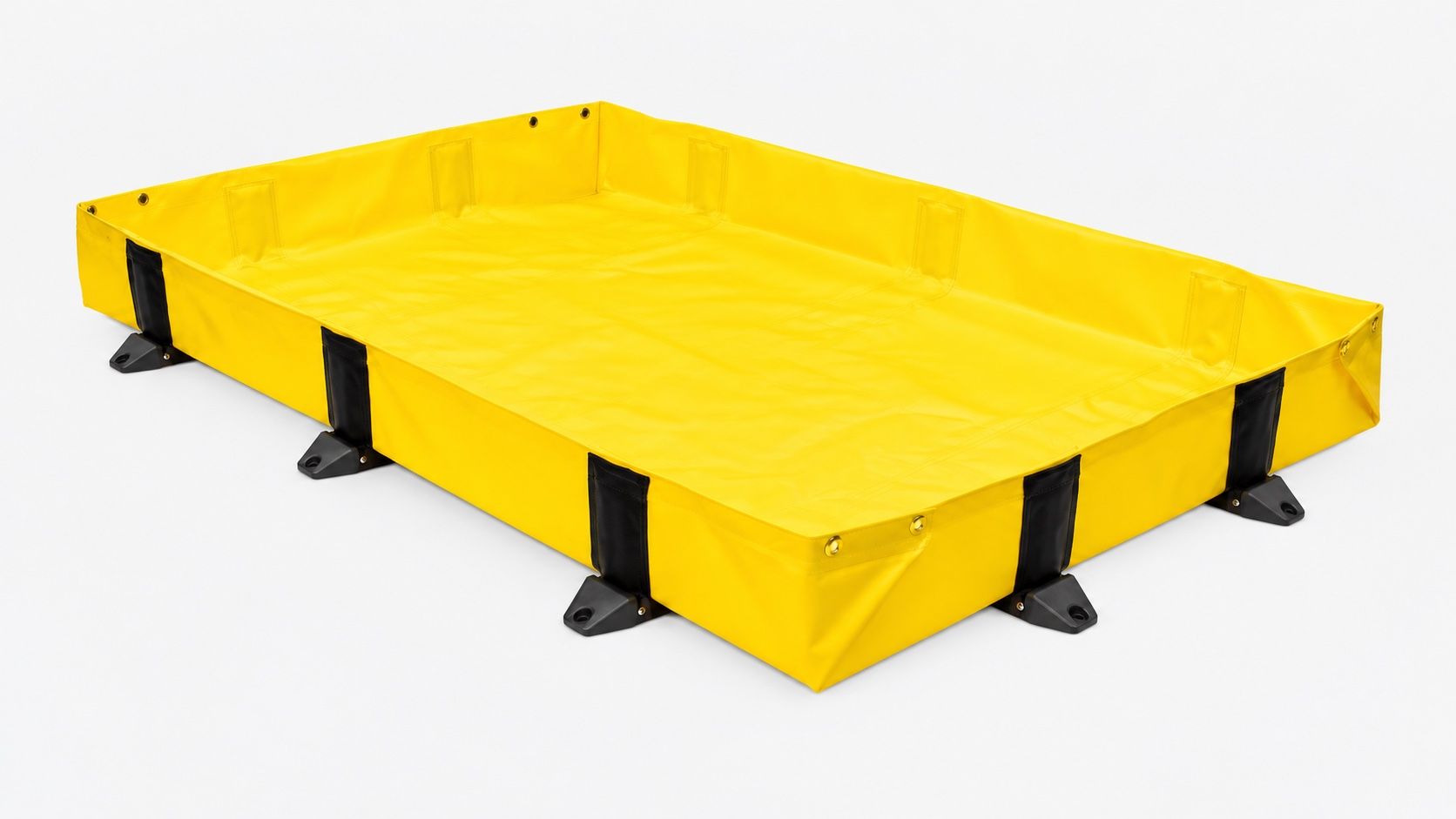
What an L-bracket spill berm is
It is a flexible spill containment berm: a portable secondary containment tray made of coated fabric rather than moulded plastic or steel. Put drums, IBCs, a generator, a tank or a vehicle inside it, and a leak stays on the floor of the berm instead of reaching the ground or a drain. Buyers in the UK and Ireland call the same thing a flexible spill containment bund or a portable containment bund.
What makes this one an L-bracket berm is how the wall is held up. The floor and the four walls are cut from one specification of PVC-coated polyester and welded together, and a sleeve is welded down the outside of each wall at intervals around the perimeter. A rigid angle bracket slides into each sleeve: the upright leg holds the wall at a right angle, and the foot rests flat on the ground just outside the berm, where it takes the outward push of the contained liquid. The same berm is catalogued as an angle-bracket berm or, where the bracket is not strictly L-shaped, a bracket-supported containment berm.
Nothing is glued, sewn or bolted into the containment area, so there is no route for liquid to get out through the wall. Slide the brackets out of their sleeves and the walls have nothing holding them: they lie flat, and the berm folds into a pack while the brackets travel separately.
Two other wall systems solve the same problem differently: foam wall berms keep a low wall upright with foam and let you drive over it, and self-rising berms let the liquid lift the wall. All three compared.
Features
Brackets carry the wall, not foam
A sleeve is welded down the outside of each wall at intervals around the perimeter. A rigid angle bracket slides into it and its foot rests flat on the ground just outside the berm, taking the outward push of the liquid.
Higher walls, more capacity
At the same footprint a 12 in wall holds two to three times what a 4–6 in foam wall holds. That is what makes this the type used for IBCs, tanks and longer storage.
Open a side to load
Pull the brackets out of one wall and lay it flat, drive or roll the equipment in, then refit them. No lifting over a standing wall.
Welded, liquid-tight floor
PVC-coated polyester is CNC-cut and joined by high-frequency or hot-air welding, so there are no stitch holes anywhere in the containment area.
Packs down for transport
Brackets travel in their own bag and the fabric folds, so one berm ships and stores as two compact packages.
Grommets along the top edge
Brass grommets set into the reinforced top hem let the berm be tied down, hung to drain or pegged out on an exposed site.
The floor is PVC-coated polyester, not a PE tarp. How the fabric is built, and how we weld it.
Sizes and capacities
Every berm is made to order, in any length and width. The footprints below are the ones Western catalogues are built around, so they are the easiest to compare a quote against. Capacity is geometric: inner floor size × wall height, filled level, before anything is placed inside.
| Ref. | Inner floor size | Capacity by wall height | |
|---|---|---|---|
| 8 in (200 mm) wall | 12 in (305 mm) wall | ||
| LB-4x4 | 4 × 4 ft 1220 × 1220 mm | 79.8 US gal 302 L | 120 US gal 453 L |
| LB-4x6 | 4 × 6 ft 1220 × 1830 mm | 120 US gal 453 L | 180 US gal 680 L |
| LB-6x6 | 6 × 6 ft 1830 × 1830 mm | 180 US gal 680 L | 269 US gal 1,019 L |
| LB-8x8 | 8 × 8 ft 2440 × 2440 mm | 319 US gal 1,208 L | 479 US gal 1,812 L |
| LB-10x10 | 10 × 10 ft 3050 × 3050 mm | 499 US gal 1,888 L | 748 US gal 2,832 L |
| LB-12x12 | 12 × 12 ft 3660 × 3660 mm | 718 US gal 2,718 L | 1,077 US gal 4,078 L |
| LB-12x20 | 12 × 20 ft 3660 × 6095 mm | 1,197 US gal 4,531 L | 1,795 US gal 6,796 L |
| LB-12x50 | 12 × 50 ft 3660 × 15240 mm | 2,992 US gal 11,327 L | 4,488 US gal 16,990 L |
Check the floor space, not just the berm. The table gives the inner floor size, which is what the capacity is calculated from. The bracket feet stand outside the walls, so the space the berm actually occupies is larger in both directions. Western catalogues for this type publish an interior and an exterior dimension side by side for exactly this reason, and we quote both. Given on the quotation for the sizes you ask about — every size is cut to order, so there is no single figure to publish
Longer, narrower or taller than anything in the table? Send the dimensions and the volume you have to hold. A berm wider than the fabric roll has a welded seam in the floor. It is welded, never stitched, and tested like the rest of the berm — where your size needs one we tell you how many and where, on the quotation, rather than leaving you to find it on delivery
Work out a size
Enter the inner floor size and wall height to see the geometric capacity. To size for a regulation, start from the container volume you must hold, subtract the volume of anything standing inside the berm, and allow for rain outdoors.
Wall height is a sizing lever, not just a number
Most buyers pick a footprint first and take whatever wall comes with it. That is backwards. On this berm the wall is the cheapest variable you have, and doubling it halves the floor you need.
Work it from the rule rather than the catalogue. One IBC needs 275 US gallons of containment under the US container storage rules. That is about 37 sq ft of floor at a 12 in wall — and about 18 sq ft at 24 in. Same tote, same regulation, half the yard.
Put concretely: a 6 × 6 ft berm holds 269 US gal with 12 in walls and 539 US gal with 24 in walls. Nothing about the footprint changed.
The catch is on the outside. A bracket works by leverage, so a 24 in wall needs a much longer leg on the ground than a 12 in one. You win floor space inside the berm and give some back around it — which is the opposite trade to the one most people expect.
At this height the brackets are steel rather than aluminium. A two-foot aluminium leg flexes under a full berm; steel does not. aluminium at 8–12 in, steel at 24 in, with the leg matched to the wall height
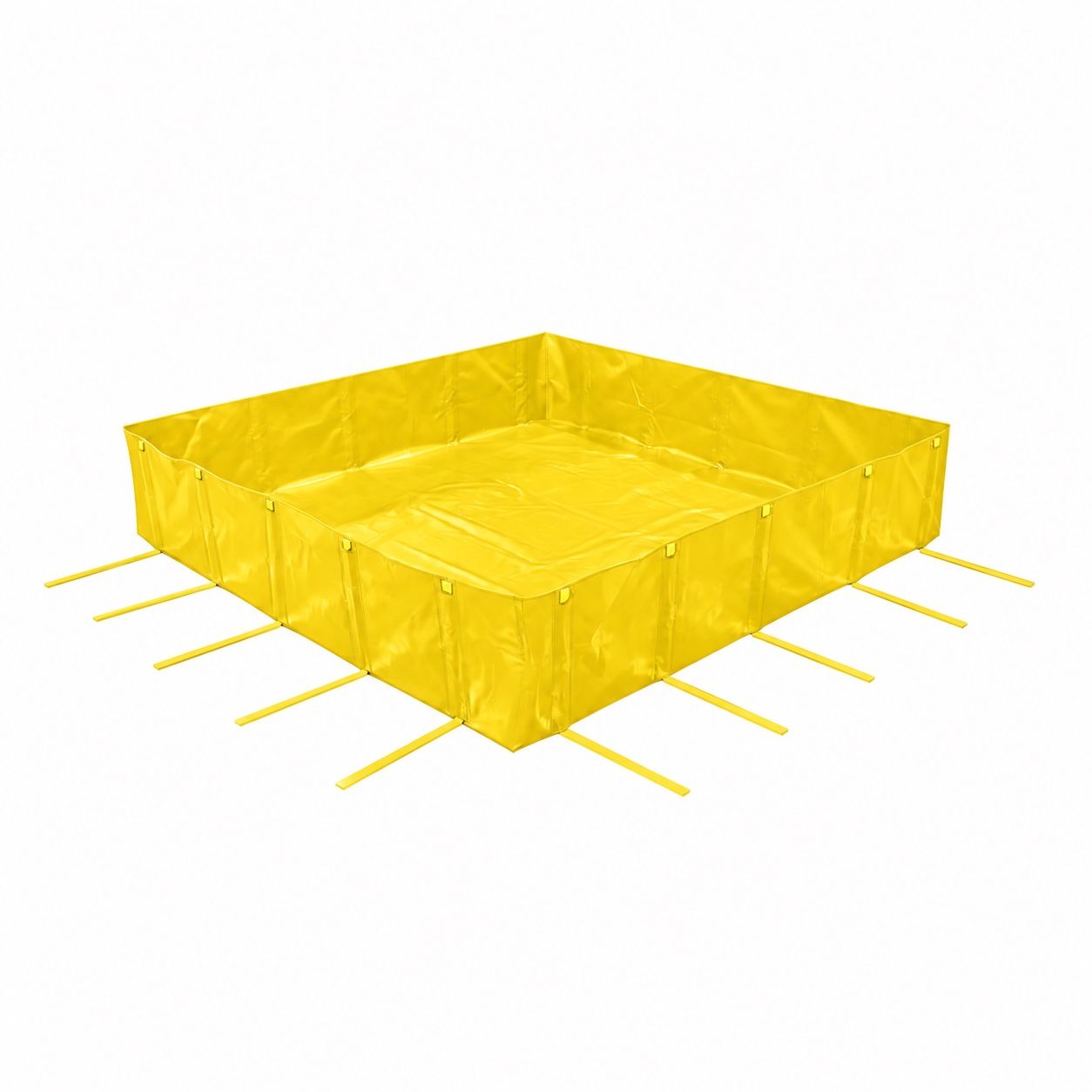
Sizes at a 24 in (610 mm) wall
| Ref. | Inner floor size | Capacity at a 24 in (610 mm) wall |
|---|---|---|
| LB-10x10-24 | 10 × 10 ft 3050 × 3050 mm | 1,496 US gal 5,663 L |
| LB-10x24-24 | 10 × 24 ft 3050 × 7315 mm | 3,591 US gal 13,592 L |
| LB-15x15-24 | 15 × 15 ft 4570 × 4570 mm | 3,366 US gal 12,743 L |
| LB-20x20-24 | 20 × 20 ft 6095 × 6095 mm | 5,984 US gal 22,653 L |
Any footprint at any of these heights is made to order — these rows are the ones the market is built around, so they are the easiest to compare a quote against.
L-bracket berm or foam wall berm?
Both are flexible PVC trays that fold away. The wall is what separates them, and the wall is what decides how much the berm holds and how you get equipment into it.
| Foam wall berm | L-bracket berm | |
|---|---|---|
| How the wall stands | Foam sealed inside the wall sleeve | Removable L-bracket in a sleeve on the outside of the wall |
| Usual wall height | 4–6 in (100–150 mm) | 8–12 in (200–305 mm) |
| Capacity at 4 × 6 ft | about 89.8 US gal with a 6 in wall | about 180 US gal with a 12 in wall |
| Getting equipment in | Step on or drive over the wall; it compresses and recovers | Take the brackets out of one wall and lay it flat, then refit them |
| Set-up | Unfold it and the walls stand | Unfold, then fit the brackets around the perimeter |
| Typical use | Drums, generators, machinery, short jobs and frequent access | IBCs, tanks, transformers, vehicles and longer-term storage |
Want the same wall height with nothing loose to lose? Stay-supported spill berms brace the wall with triangular stays that stay on the berm — at the cost of more floor space outside it.
Foam wall spill berms · All berm types and fabric weights
Products this is often confused with
Not a spill deck
A spill deck is a small platform with a grating on top, for one to a few drums standing in place. An L-bracket berm is a much bigger tray, sized in feet rather than drums, for IBCs, tanks or several drums in one footprint.
Not a spill tray
A spill tray is small, shallow and folded from one piece, and it catches drips under a part or a can. A berm is sized in feet and built to hold a whole container volume. We make both — they are not alternatives to each other.
Not a foam wall berm
A foam wall berm has foam sealed inside a low wall and no external parts, so you can drive over the wall. Different job, and we make those too.
Not a self-rising berm
On a self-rising berm the wall lies flat until liquid lifts it. There is nothing to fit and nothing to remove, but the wall only stands when there is a spill.
Specifications
| Product | Portable PVC L-bracket spill containment berm — also catalogued as an angle-bracket or bracket-supported berm, and in the UK as a portable containment bund |
|---|---|
| Construction | PVC-coated polyester floor and walls, CNC-cut, high-frequency or hot-air welded; brackets drop into sleeves welded to the outside of the wall |
| Bracket | Rigid angle bracket in a welded sleeve on the outside of the wall. Aluminium at 8–12 in; steel at 24 in, where an aluminium leg would flex. The bracket lifts out of its sleeve so the berm folds flat, and the leg is matched to the wall height |
| Wall height | 8 in, 12 in and 24 in (200, 305 and 610 mm). Doubling the wall halves the floor area a given volume needs |
| Fabric weight | 18 oz/yd² (610 g/m²) as standard, or 22 oz/yd² (745 g/m²) heavy duty where the ground or the traffic is rough. We also run 40 oz/yd² (1355 g/m²) for rail work |
| Sizes | Any length and width, made to order. Quoted on the inner floor size; the brackets add to the floor space needed outside the walls |
| Outside footprint | The bracket stands outside the wall, so the overall footprint is larger than the inner floor. Given on the quotation for the sizes you ask about — every size is cut to order, so there is no single figure to publish |
| Top edge | Reinforced hem with brass grommets for tying down, draining or pegging out |
| Corners | Cut and welded, not stitched. There is no needle hole anywhere in the containment area |
| Colour | High-visibility yellow with black bracket sleeves and feet as standard. Yellow, black, blue, orange and green, at no extra cost and with no separate minimum — the colour is a choice of fabric roll, not a pigment batch, so changing it costs us nothing and we do not charge for it |
| Capacity | Geometric: inner length × width × wall height, level, before anything is placed inside |
| Weight | Berm and brackets listed separately. Given on the quotation for the sizes you ask about — every size is cut to order, so there is no single figure to publish |
| Folded size | Folded fabric and bracket bundle listed separately. Given on the quotation for the sizes you ask about — every size is cut to order, so there is no single figure to publish |
| Temperature range | Ask us with your climate and your liquid. We would rather check the fabric and the foam against your conditions than publish one range and have you assume it covers a cold store or a desert yard |
| Anchoring | Outdoors an outside-braced berm is held down rather than weighted by its own contents. The market does this two ways: sandbags laid on a welded skirt, or ground stakes through grommets in the skirt or tarp |
| Liquids | Send the Safety Data Sheet so the fabric can be checked before you order |
| Options | Drain fitting, ground tarp, track belt, bags, spare brackets, repair kit. All of them. Ground tarps, track belts, skirts, carry bags and repair kits are made in our own factory rather than bought in, so they are quoted and shipped with the berm as one order |
| Branding | Private label and custom packaging for OEM orders |
| Quality | Every berm — not a sample — is filled with water and left standing for two hours before packing, signed off by the production manager and given a batch number |
| Documents | A material specification for the fabric in your order, and an independent laboratory test report where your process needs one — we send material from your own order to a third-party lab and pay for it. We hold no ISO certification and will not imply one |
| MOQ | 20 units per size. That is low for made-to-order containment, and it is deliberate: a distributor should be able to test a size on a real order rather than commit to a container of it |
| Lead time | Production takes 15 working days for up to 50 units and 25 working days for 50 to 200. Above 200 units we schedule it with the order. The clock starts when your deposit reaches us, not when the order is placed |
| Samples | Samples take 5 working days. We charge for the sample — the amount depends on the size, so it is quoted with your request — and we refund that charge against your first production order. Sample freight is on the buyer |
| Packing | Every size packs differently, so there is no single carton spec worth publishing. Folded size, carton dimensions and gross weight go with the quotation for the sizes you are ordering — before you commit to freight, not after |
Helps a site meet the secondary containment it has to provide under the US SPCC rule (40 CFR 112) and the container storage rules (40 CFR 264.175), or UK oil storage regulations, when it is sized for the containers it serves. No containment product is "EPA certified". What the rules actually require.
Where L-bracket berms are used
IBCs and totes
One or several 1,000 L IBCs on a yard or workshop floor, where a low foam wall could not hold the volume required.
Drum storage
Rows of 205 L drums held together in one tray instead of a rigid pallet per pair.
Temporary tanks
Under bowsers, day tanks and frac tanks placed on site for a job or a season.
Generators and transformers
Around fuel-carrying plant that stays in place, where the containment has to hold the whole tank volume.
Vehicle and plant parking
Long, narrow berms under trucks and machinery; drop a wall to drive in, refit the brackets behind it.
Wash-down and decontamination
Collecting wash water and run-off, usually with a drain fitting and a track belt under the wheels.
Accessories
Ground tarp
Goes under the berm on gravel or rough concrete so stones cannot work through the floor.
Track belt
A wear layer where wheels cross the floor repeatedly.
Drain fitting
Lets rainwater or collected liquid out through a hose instead of being pumped.
Bracket bag and berm bag
Brackets and fabric pack separately, which is how the berm survives repeated site moves.
Spare brackets
The part most likely to be lost or bent on a busy site.
Repair kit
Patch material and adhesive to keep a berm in service after damage.
Sizes, grades and the welded-in option: ground tarps, track belts and repair kits.
How to order
- Send the size and use: inner size or equipment footprint, wall height or the volume to hold, the liquid, quantity and destination.
- Get a quote by email, with the bracket specification, options and packing for your order.
- Approve a sample for new sizes or private-label ranges.
- Production and shipment from our factory in Taizhou, Zhejiang, China.
For distributors
Build a collapsible berm range under your own name: your footprints, wall heights, model codes, labels and cartons. Because the brackets ship separately, a private-label range can share one bracket specification across several berm sizes.
Questions about L-bracket spill berms
What is an L-bracket spill berm?
A portable secondary containment tray made of PVC-coated polyester, whose side walls are held upright by L-shaped brackets. Each bracket slides into a sleeve on the outside of the wall and its foot rests on the ground just outside the berm, taking the outward push of the liquid. Slide the brackets out and the walls drop flat for storage and transport.
Is a collapsible containment berm the same as an L-bracket berm?
"Collapsible containment berm" is the catalogue heading; it covers several ways of making a wall collapse, including L-brackets, folding PVC wall frames and built-in struts. An L-bracket berm is the version with loose brackets in sleeves, and it is the type we build.
Is a collapsible spill bund the same product?
Yes. Buyers in the UK, Ireland and Australia say bund rather than berm, so the same product is sold as a collapsible spill bund, a portable bund or portable bunding. UK specifications usually give the wall height in millimetres and the capacity in litres.
What is the difference between a foam wall berm and an L-bracket berm?
A foam wall berm has foam sealed inside low walls, usually 4 to 6 inches high; you can step on or drive over the wall and it springs back. An L-bracket berm has higher walls, usually 8 to 12 inches, so it holds far more at the same footprint, but the wall is rigid while the brackets are in and you open one side to load it.
How do you set up an L-bracket spill berm?
Unfold the berm on a clear surface, then work around the perimeter sliding one bracket at a time into its sleeve until each foot sits flat on the ground. Leave one wall until last so equipment can be brought in over it. Packing down is the same steps in reverse.
Can you drive over an L-bracket berm?
Not over a standing wall. With the brackets fitted the wall is rigid and a wheel would damage it. To drive in, remove the brackets from one wall so it lies flat, drive over that wall, then refit the brackets behind the vehicle. If you need a wall that can be driven over while it is standing, use a foam wall berm instead.
How much liquid does a 4 × 6 ft L-bracket berm hold?
A 4 × 6 ft floor with 12 in walls holds about 180 US gallons (680 litres) filled level to the top of the wall. With 8 in walls the same floor holds about 120 US gallons (453 litres). Subtract the volume of anything standing inside, and allow for rain if the berm is outdoors.
What wall heights do you offer?
Western catalogues for this type are built around 12 in (305 mm) walls, with 8 in (200 mm) versions for lower volumes; UK bunds are commonly 250 mm. We cut the wall to the height you specify, so tell us the volume you have to hold rather than picking a height first.
Which liquids can it contain?
PVC-coated fabric is commonly used for diesel, lubricating oils and hydraulic fluids. Some fuels, solvents and aromatic chemicals attack PVC. Send the Safety Data Sheet of the liquid so the material can be checked before you order.
Are spill berms EPA certified?
No. The US EPA does not certify spill containment products. Under the SPCC rule (40 CFR 112) and the container storage rules (40 CFR 264.175) the facility has to provide adequate secondary containment, and a berm can be part of that when it is sized for the containers it serves.
Do you make L-bracket berms under our brand?
Yes. OEM supply is our core business: we make berms for distributors, catalogue sellers and rental companies under their own brand, model numbers and packaging.
Specifications on this page are confirmed with the factory; anything still marked TBC is a gap we have left visible rather than filled with a plausible number. Checked by the production team at Taizhou Fengxu Textile Industry Co., Ltd. on . How we verify what is on this site.
Quote an L-bracket spill berm
Send the inner size or equipment footprint, the liquid, the quantity and the destination. We reply with a quote by email.