
Transfer containment · Drain fitted
Tanker truck and railcar spill containment berms
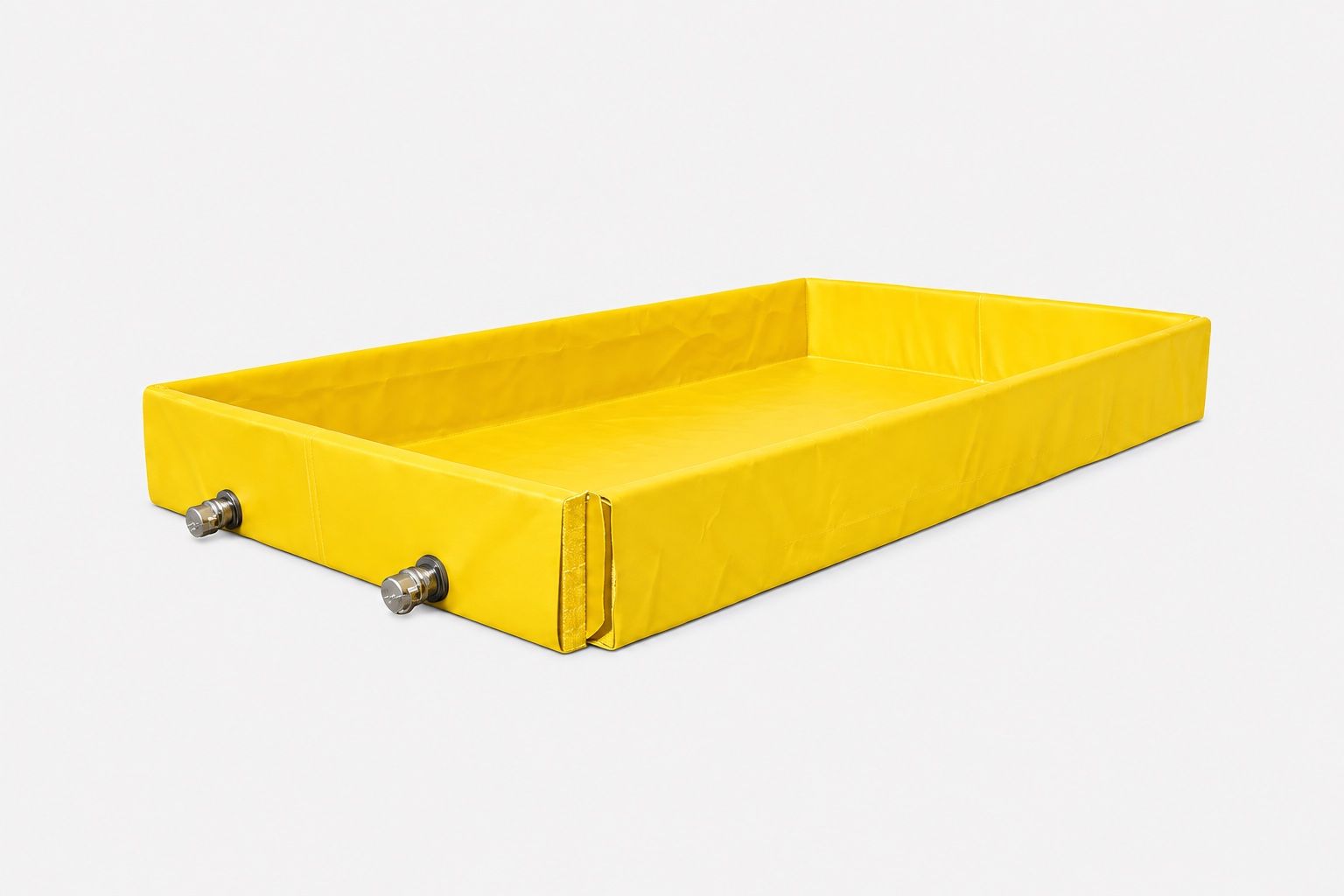
A portable PVC-coated polyester berm that sits under the discharge point of a tanker truck or a rail tank car while it is loading or unloading, and empties through a drain fitting in the wall instead of being tipped. Built to size in our Taizhou factory for OEM and private-label distributors in the US.
- Cam-and-groove drain fittings, so a full berm empties through a hose
- Walls at 12 in (305 mm), the height this category is built to
- Sized to sit under a discharge point, not around the whole vehicle
- Welded PVC-coated polyester floor with no stitch holes
- Any footprint, at any wall height, OEM and private label
Which berm this is, and which it is not
Three different jobs get asked for with the same words. Sending the wrong one costs a return, so it is worth being blunt about the difference before anyone specifies a size.
Already leaking, rather than dripping from a valve during a scheduled transfer? That is a different product: a railcar spill containment berm straddles the rail itself and drains through camlock fittings to a waste container.
| What you need | Which berm | Roughly what size |
|---|---|---|
| Catch drips at the coupling while a tanker or railcar transfers | This page. Smaller than the vehicle, with a drain | 5 × 10 to 10 × 10 ft |
| Park the whole vehicle inside containment and drive out again | A drive-through berm — the vehicle sits inside it | Larger than the vehicle |
| Sized secondary containment around a frac tank or a stored tanker | Custom berm, sized from the tank volume | 10 × 20 up to 12 × 50 ft |
| Stand drums, an IBC or a machine on containment | L-bracket or stay-supported berms | 4 × 4 to 12 × 12 ft |
How much capacity the rules require depends on what is stored and where. This product helps an operator provide containment; it does not by itself make a site compliant.
The drain is the point
Every other berm we make is emptied by pumping from above or by lifting one wall. Neither works on a transfer pad: the berm is under a vehicle, it may be holding product rather than rainwater, and the crew wants it clear before the next truck arrives.
A cam-and-groove fitting — the coupling most site hoses and vacuum trucks already use — passes through the wall at floor level. Two fittings on one wall let the berm drain completely without being moved. Between transfers they carry dust caps.
- Fitting size: 2 in is the Western catalogue standard. 2 in is the Western catalogue standard and what we fit unless you ask for another size.
- Fitting material: specified to the liquid — tell us what it is and we will say which.
- How it seals into the wall, and whether it can be replaced in the field: welded into the wall, and replaceable.
Sizes and capacities
Capacities below are geometric, calculated from the inner floor size at a 12 in wall. Usable capacity is lower once equipment, wind or an uneven surface is taken into account. Any footprint can be made — these are reference sizes, not a stock list.
Transfer catch
Goes under the discharge point during loading and unloading.
| Reference | Inner floor | Metric | Capacity (US gal) | Capacity (L) |
|---|---|---|---|---|
| TB-5x10 | 5 × 10 ft | 1525 × 3050 mm | 374 | 1,416 |
| TB-6x12 | 6 × 12 ft | 1830 × 3660 mm | 539 | 2,039 |
| TB-8x10 | 8 × 10 ft | 2440 × 3050 mm | 598 | 2,265 |
| TB-10x10 | 10 × 10 ft | 3050 × 3050 mm | 748 | 2,832 |
Full tank containment
Surrounds a frac tank or a stored tanker. 12 × 50 ft is the footprint Western catalogues standardise on for a frac tank.
| Reference | Inner floor | Metric | Capacity (US gal) | Capacity (L) |
|---|---|---|---|---|
| TB-10x20 | 10 × 20 ft | 3050 × 6095 mm | 1,496 | 5,663 |
| TB-12x20 | 12 × 20 ft | 3660 × 6095 mm | 1,795 | 6,796 |
| TB-10x50 | 10 × 50 ft | 3050 × 15240 mm | 3,740 | 14,158 |
| TB-12x50 | 12 × 50 ft | 3660 × 15240 mm | 4,488 | 16,990 |
The largest sizes depend on how wide a panel we can weld in one piece. Confirm before specifying anything over 20 ft: A berm wider than the fabric roll has a welded seam in the floor. It is welded, never stitched, and tested like the rest of the berm — where your size needs one we tell you how many and where, on the quotation, rather than leaving you to find it on delivery. Weight and folded pack size per size: Given on the quotation for the sizes you ask about — every size is cut to order, so there is no single figure to publish.
Why our 10 × 10 holds more than their 10 × 10
Several Western catalogues state plainly that their published measurements are outside dimensions, and their capacity figures are calculated on that outside box. That counts the thickness of the wall as if it were containment volume.
On a 10 × 10 ft berm with a 12 in wall the difference is around ten percent — a catalogue figure of 748 gal is nearer 675 gal of usable space inside the walls. We quote from the inner floor, so a berm we call 10 × 10 ft has ten usable feet in each direction and is physically larger overall.
When you compare quotes, check which dimension each capacity was calculated from. If you need a specific outside footprint because of where the berm has to fit, give us that and we will work back from it.
Fabric and build
- Fabric. PVC-coated polyester, cut and welded with no stitching in the containment area. How the fabric is built. Weight offered for transfer duty: 18 oz/yd² (610 g/m²) as standard, or 22 oz/yd² (745 g/m²) heavy duty where the ground or the traffic is rough. We also run 40 oz/yd² (1355 g/m²) for rail work.
- Walls. Closed-cell foam sealed in a welded sleeve, standing 12 in (305 mm). Closed-cell polyethylene foam, sealed inside a welded sleeve. Closed cell, not open cell: a wall that has to stand in standing liquid — and on some of our berms float up in a spill — cannot be a sponge, and a cut in the cover does not turn it into one. The wall is square in section, as wide at the base as it is tall. A 4 in (100 mm) wall takes 4 in of floor along each side, a 6 in (150 mm) wall takes 6 in — so the inner floor is always the outside size less twice the wall height.
- Removable foam. Foam that pulls out of its sleeve lets the berm fold much flatter for transport. Whether we can build the walls that way: sealed in, because a wall that has to stand in liquid should not have a seam a user can open.
- Corners. Hook-and-loop closures let a wall be opened or laid down. cut and welded, not stitched.
- Testing. Each berm is leak-tested before it ships. every berm is filled with water and left standing for two hours, signed off by the production manager and given a batch number.
- Colour. High-visibility yellow as standard. Yellow, black, blue, orange and green, at no extra cost and with no separate minimum — the colour is a choice of fabric roll, not a pigment batch, so changing it costs us nothing and we do not charge for it.
What goes with it
Hose stand
A tanker hose is heavier than a foam wall. Left lying across the wall it crushes it and the containment leaks at exactly the moment it is needed. A stand carries the hose over the wall instead.
Ground tarp
A sacrificial sheet under the berm, cut larger than the footprint, takes the abrasion from gravel and yard debris so the welded floor does not.
Track belts
Strips laid inside the berm along the wheel path, for berms that vehicles are driven into.
Rainwater bailer
Outdoor berms fill with rain. A bailer lets water out while holding oil back, so the berm still has capacity when a spill happens.
Which of these we can supply: All of them. Ground tarps, track belts, skirts, carry bags and repair kits are made in our own factory rather than bought in, so they are quoted and shipped with the berm as one order
How this berm earns its keep
Catching the transfer, not the tank
Couplings drip every time a hose comes off. This berm goes on the ground under the discharge point while a tanker truck or railcar is loading or unloading, and comes up again when the transfer is done. It is deliberately smaller than the vehicle.
It empties without being moved
A drain fitting through the wall at floor level lets a crew put a hose on and pump the contents into a tote, a drum or a vacuum truck. A berm with no drain has to be pumped from above or tipped, which is not possible with a vehicle standing over it.
It handles being used every day
Transfer containment is not emergency equipment that sits in a cupboard. It is dragged out, driven past, hosed down and folded up on every shift, so the fabric and the welds are specified for that, not for a one-off spill.
It travels with the truck
Fleet buyers carry containment on the vehicle. Folded pack size and weight decide whether it lives in the side locker or gets left at the depot, so both are quoted with the berm.
Questions about transfer containment
Can the berm be emptied while the vehicle is still over it?
That is what the drain fitting is for. The fitting passes through the wall at floor level, so a hose connects from outside the berm and the contents go to a tote, a drum or a vacuum truck. Nothing has to be lifted, tipped or reached over.
Is this the same as a drive-through berm?
No, and the difference is which one is bigger. A drive-through berm is larger than the vehicle and the vehicle parks inside it. This berm is smaller than the vehicle and sits under the discharge point while the vehicle stands outside it. If you need the whole truck inside the containment, ask about drive-through berms instead.
Will it hold 110 percent of my tank?
Not at these sizes, and it is not meant to. Transfer-catch berms hold the volume of a coupling failure, not the volume of a tank. Sized secondary containment around a frac tank or a parked tanker is a much larger berm, usually 10 to 12 ft wide and up to 50 ft long. We quote those as custom sizes. The sizing guide explains how the required volume is worked out.
How are your capacities measured?
From the inner floor size, which is the usable area inside the walls. Several Western catalogues publish capacity calculated on outside dimensions, which counts the wall thickness as containment volume and reads roughly ten percent high on a 10 × 10 ft berm. If you are comparing our figures with a catalogue, check which dimension the other capacity was calculated from.
What size drain fitting do you fit?
Two-inch cam-and-groove is the size Western catalogues fit to berms of this type, and it is what most site hoses and vacuum trucks connect to. Confirm the sizes and materials we can supply before you specify, and tell us if your fleet standardises on something else.
Can it be left outdoors between transfers?
It can, but plan for rain. An open berm collects every millimetre that falls on its footprint, and that volume comes out of the capacity available for a spill. Either empty it through the drain after rain, or ask about a bailer that lets water out and holds oil back.
Do you supply these under our own brand?
Yes. These are made to order in our own factory, so the fabric colour, the printed markings, the model references and the packaging can all be yours. There is no catalogue brand on the product unless you put one there.
Specifications on this page are confirmed with the factory; anything still marked TBC is a gap we have left visible rather than filled with a plausible number. Checked by the production team at Taizhou Fengxu Textile Industry Co., Ltd. on . How we verify what is on this site.
Quote a tanker or railcar transfer berm
Send the inner size or equipment footprint, the liquid, the quantity and the destination. We reply with a quote by email.