
Folding struts · Stows in a response vehicle
Compact folding spill berms
A containment berm whose wall struts are hinged, so they fold flat against the wall rather than standing out across the ground. It packs down small enough to live on a response truck instead of in a store room, and there is nothing to inflate and nothing to lose. Made to size in our Taizhou factory for OEM and private-label distributors in the US, UK and Europe.
- Struts fold flat against the wall, not out across the ground
- Packs smaller than a braced berm of the same size
- Sized to live in a response vehicle, not a store room
- No pump, no air — right for containment nobody is standing over
- Any footprint, made to order, OEM and private label
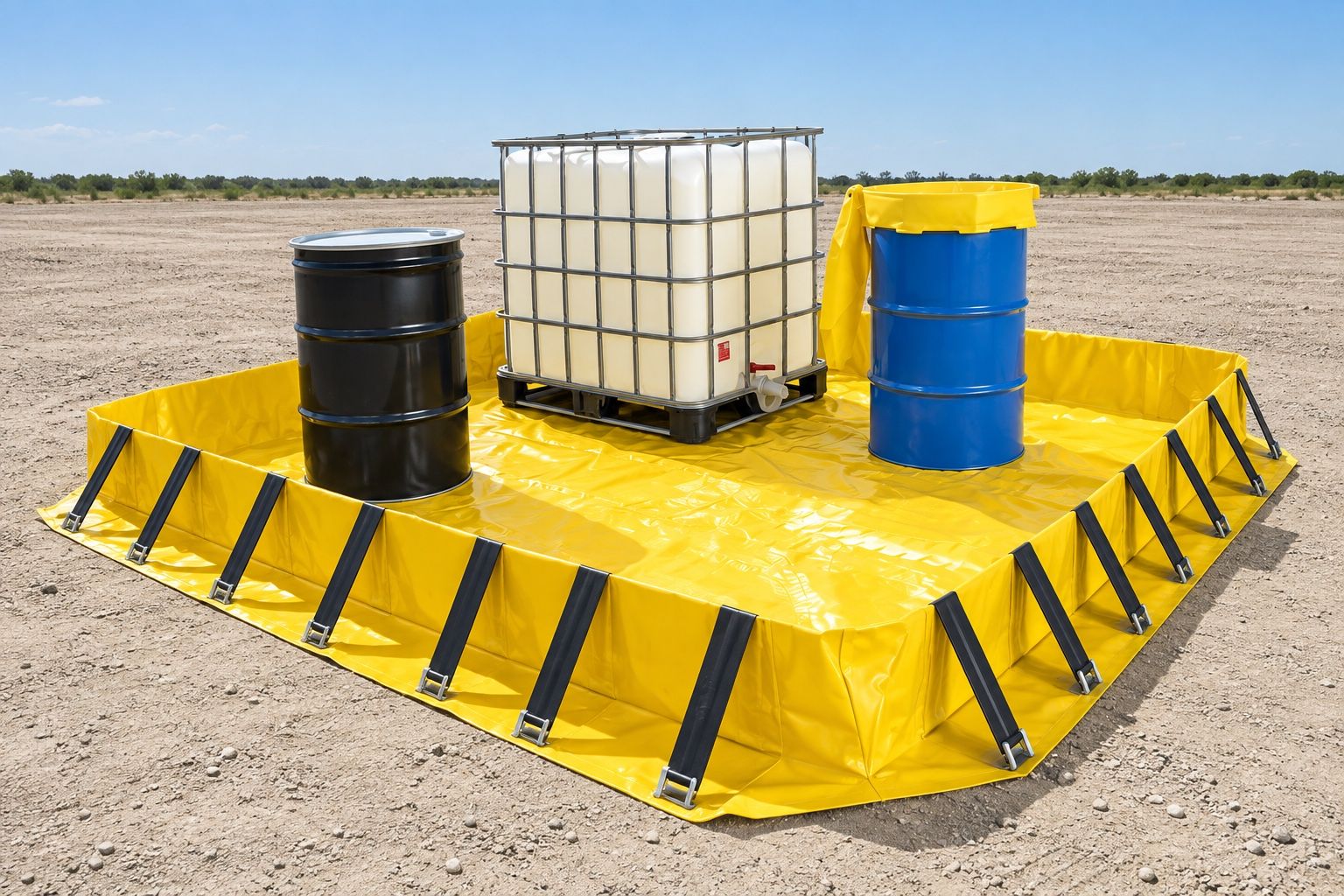
Three ways to hold a wall up, and what each costs you
Every flexible berm faces the same problem: a wall of coated fabric will not stand by itself. There are three answers in the market, and the right one depends on whether your berm stays put or travels.
| Folding strut (this berm) | Triangular stay | Inflated wall | |
|---|---|---|---|
| How the wall stands | A hinged strut swings up against the wall | A triangle: base bar on the ground plus a diagonal | An air chamber in the wall is pumped up |
| Ground needed outside the wall | A small foot per strut | A base bar about as long as the wall is high | None |
| Folded size | Small — the struts lie flat on the wall | Larger — the triangles fold with it | Smallest of the three |
| What can go wrong | A bent strut, replaceable | A bent stay, replaceable | A puncture takes the wall down, and you need the pump |
| Set-up needs | One person, no tools | One person, no tools | A pump and a power source |
Lower walls that you simply step over are a different product again — foam wall spill berms. For vehicles going in and out repeatedly with nothing to fold at all, see drive-through spill berms.
Features
The strut folds, it does not detach
Each strut is hinged part-way along, so it collapses against the wall instead of being pulled out. Nothing to unclip, nothing to count back into a bag, nothing to leave on the ground.
Almost nothing outside the wall
A small foot at the base of each strut is all that sits outside the berm. There is no long bar running out across the ground, which is what lets the berm go closer to a wall and pack down flatter.
Deployed by one person
Unroll it, walk the perimeter swinging the struts up, and it is ready. The slow part of setting out a braced berm is fitting loose hardware, and there is none here.
A wall still drops for access
Fold the struts on one side and that wall lies flat, so equipment goes in over it and the struts come back up behind.
Welded, liquid-tight floor
PVC-coated polyester, CNC-cut and joined by high-frequency or hot-air welding. No stitch holes anywhere below the liquid line.
Right for containment nobody is watching
An inflated wall packs smaller again, and where a berm is staffed for as long as it is in use — a disinfection line, a decon checkpoint — that trade is often worth it. This berm is built for the opposite case: a drum, a generator or a tote left contained for days or weeks between site visits. A slow puncture there empties the wall before anyone is back to see it. A folding strut can bend; it cannot go flat unnoticed.
The floor is PVC-coated polyester, not a PE tarp. How the fabric is built, and how we weld it.
Sizes and capacities
Every berm is made to order. The footprints below span the range this class is normally sold in, from a single-tote square up to a tanker-length run.
| Ref. | Inner floor size | Capacity at a 12 in (305 mm) wall |
|---|---|---|
| CF-6x6 | 6 × 6 ft 1830 × 1830 mm | 269 US gal 1,019 L |
| CF-10x10 | 10 × 10 ft 3050 × 3050 mm | 748 US gal 2,832 L |
| CF-12x12 | 12 × 12 ft 3660 × 3660 mm | 1,077 US gal 4,078 L |
| CF-12x40 | 12 × 40 ft 3660 × 12190 mm | 3,591 US gal 13,592 L |
| CF-14x54 | 14 × 54 ft 4265 × 16460 mm | 5,655 US gal 21,408 L |
| CF-15x66 | 15 × 66 ft 4570 × 20115 mm | 7,406 US gal 28,034 L |
Capacity is geometric: inner floor size × wall height, filled level, before anything is placed inside. Subtract the volume of whatever stands in it, and allow for rain outdoors. How much capacity the rules require.
The number nobody publishes
This product is sold on one thing: how small it is when it is folded. It is the figure that decides whether a berm gets carried on a truck or left in the depot.
No manufacturer in this class publishes it. We checked. The pages say "compact", "folds into a tight package", "minimal space required" — and then give you a shipped weight and nothing else.
We will publish a folded length, width and height for every size, measured on a production sample rather than estimated. Until then it is blank here rather than vague. Measured on a production sample rather than estimated, and not finished yet. Ask us for the current figure with your enquiry — it is the number this product is chosen on, so we are not going to approximate it.
If you are comparing against an air-walled berm
An inflated wall does fold smaller than a strut — there is no rigid part in it at all. If packed volume is the only criterion, that is the honest answer.
What it costs you is a dependency and a failure mode, and how much that matters depends on who is watching. You need a pump and something to run it from, and a puncture drops the wall rather than just needing a patch later — manageable if someone is standing right there to react, a real problem if the berm is left containing something unattended between visits.
Where someone is standing there, we build the air-rimmed kind: vehicle disinfection berms.
A folding strut is a little bulkier and has neither problem. Which matters more is a question about your sites, not about the product, so tell us how the berm gets used and we will say which we would quote.
Specifications
| Product | Compact folding spill containment berm with hinged wall struts |
|---|---|
| Construction | PVC-coated polyester floor and walls, CNC-cut, high-frequency or hot-air welded |
| Strut | Hinged part-way along so it folds flat against the wall; a small foot at the base is all that sits outside the berm |
| Wall height | 12 in (305 mm) as standard for this class; other heights made to order |
| Fabric weight | 18 oz/yd² (610 g/m²) as standard, or 22 oz/yd² (745 g/m²) heavy duty where the ground or the traffic is rough. We also run 40 oz/yd² (1355 g/m²) for rail work |
| Sizes | Any length and width, made to order |
| Folded size | The number this product is actually bought on Measured on a production sample rather than estimated, and not finished yet. Ask us for the current figure with your enquiry — it is the number this product is chosen on, so we are not going to approximate it |
| Weight | Given on the quotation for the sizes you ask about — every size is cut to order, so there is no single figure to publish |
| Capacity | Geometric: inner floor size × wall height, level, before anything is placed inside |
| Colour | High-visibility yellow as standard. Yellow, black, blue, orange and green, at no extra cost and with no separate minimum — the colour is a choice of fabric roll, not a pigment batch, so changing it costs us nothing and we do not charge for it |
| Liquids | Send the Safety Data Sheet so the fabric can be checked before you order |
| Options | Ground tarp, track belt, repair kit and tape |
| Branding | Private label and custom packaging for OEM orders |
| MOQ | 20 units per size. That is low for made-to-order containment, and it is deliberate: a distributor should be able to test a size on a real order rather than commit to a container of it |
| Lead time | Production takes 15 working days for up to 50 units and 25 working days for 50 to 200. Above 200 units we schedule it with the order. The clock starts when your deposit reaches us, not when the order is placed |
| Samples | Samples take 5 working days. We charge for the sample — the amount depends on the size, so it is quoted with your request — and we refund that charge against your first production order. Sample freight is on the buyer |
| Packing | Every size packs differently, so there is no single carton spec worth publishing. Folded size, carton dimensions and gross weight go with the quotation for the sizes you are ordering — before you commit to freight, not after |
Helps a site meet the secondary containment it has to provide under the US SPCC rule (40 CFR 112) and the container storage rules (40 CFR 264.175), or UK oil storage regulations, when it is sized for what it serves. No containment product is "EPA certified". What the rules actually require.
Where compact folding berms are used
Hazmat and spill response vehicles
A berm that lives on the truck year-round and is only unfolded when something has already gone wrong.
Emergency response lockers
Where the berm competes with everything else for shelf space, and the folded size is what decides whether it is carried at all.
Mobile maintenance crews
Fitters and fuellers who set out containment at a different location every day and strike it again the same afternoon.
Rental and hire fleets
Berms that go out and come back repeatedly, where nothing detachable survives the cycle.
Drums, IBCs and site equipment
The everyday job: containment under a tote, a generator or a row of drums for as long as they stand there.
Sites with no spare floor
Yards and plant rooms where a berm cannot have a metre of clear ground around it just to hold its own walls up.
How to order
- Send the footprint and what will stand in it, or the volume the containment has to hold.
- Say where it lives — on a vehicle, in a locker, or out on site permanently. That decides whether this is the right type at all.
- Get a quote by email, with the strut specification, options and packing.
- Production and shipment from our factory in Taizhou, Zhejiang, China.
For distributors
This is the berm that sells into response kits rather than onto yards, which means it goes out with a different catalogue and a different buyer. It also ships and warehouses smaller than anything else in the range at the same footprint, which is worth real money on a container.
Questions about compact folding berms
What is a compact folding spill berm?
A flexible containment berm whose wall struts are hinged, so they fold flat against the wall instead of coming off or standing out across the ground. It packs down smaller than a braced berm of the same footprint, which is why it is the type that ends up living on a vehicle.
How is this different from your stay-supported berm?
The brace. A stay-supported berm uses a triangle — a bar lying on the ground plus a diagonal up to the wall — which is very stable but needs clear ground all the way round and folds bulkier. This one uses a hinged strut with only a small foot outside the wall, so it sits closer to obstructions and packs smaller. If the berm lives in one place, the triangle is fine. If it lives on a truck, this one.
How small does it actually fold?
Smaller than a braced berm of the same size, and that is as precise as we are willing to be until we have measured our own. No manufacturer in this class publishes a folded size, which tells you something about how the market is sold. We will publish ours once a production sample has been folded and measured, because it is the number this product is bought on.
Do the struts come off?
No, and that is the point. They are hinged to fold against the wall, so there is no loose hardware to count, bag, lose or leave behind. A bent strut can be replaced, but nothing detaches in normal use.
Can one person set it up?
Yes. Unroll it and walk the perimeter swinging the struts up. What makes a braced berm slow is fitting loose brackets one at a time, and there are none here.
Why not an inflatable-wall berm? They fold smaller.
They do, and if absolute packed size is the only thing that matters they are worth a look. A folding strut cannot lose pressure at all, but it also cannot pack as flat. If the berm will be staffed for as long as it is deployed — a checkpoint, a response scene — that trade often favours air, and we build those too. If it is left holding something on its own between site visits, ours is the safer failure mode. Tell us which describes your sites and we will say which we would quote.
Can a vehicle drive into it?
Fold the struts on one wall and that wall lies flat, so equipment can be brought in over it and the struts go back up behind. That is not the same as our drive-through berms, whose end walls are foam and float up on their own with nothing to fold each time.
Does folding it over and over wear the fabric out?
Repeated folding is what this type is for, but a fold line that is always in the same place is the part that eventually shows wear on any coated fabric. Tell us how often it will be struck and re-deployed and we will specify accordingly.
Which liquids can it contain?
PVC-coated fabric is commonly used for diesel, lubricating oils and hydraulic fluids. Some fuels, solvents and aromatic chemicals attack PVC. Send the Safety Data Sheet of the liquid so the material can be checked before you order.
Specifications on this page are confirmed with the factory; anything still marked TBC is a gap we have left visible rather than filled with a plausible number. Checked by the production team at Taizhou Fengxu Textile Industry Co., Ltd. on . How we verify what is on this site.
Quote a compact folding spill berm
Send the inner size or equipment footprint, the liquid, the quantity and the destination. We reply with a quote by email.